Dr. Brian Anderson, a Chacruna board member, and his UCSF colleagues recently published results from the first contemporary US psychedelic-assisted group therapy clinical trial, which was designed with community engagement in the Bay Area: “Psilocybin-assisted group therapy for demoralized older long-term AIDS survivor men: An open-label safety and feasibility pilot study.” As Chacruna’s social media science editor, I am delighted to offer a brief summary of this novel clinical trial publication:
Introduction
Early in the AIDS epidemic, demoralization was identified as a clinical problem for the bereaved, defined as “existential suffering characterized by poor coping, sense of helplessness, hopelessness, and loss of meaning and purpose.” There are psychotherapies available to reduce demoralization, but their effectiveness has only been modest. A recent study conducted by Anderson et al. demonstrated that psilocybin-assisted group therapy may decrease demoralization for older long-term AIDS survivors in San Francisco
Study Design
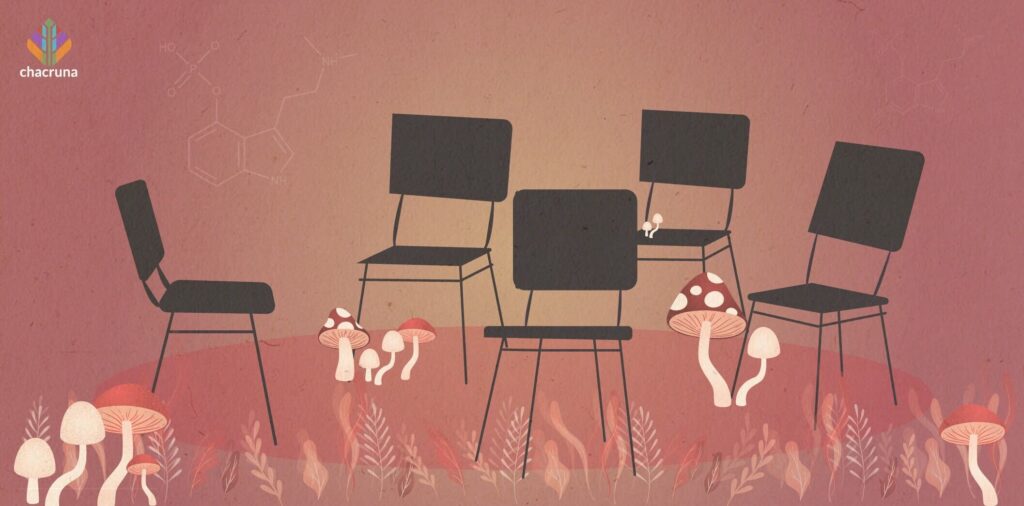
From July 2017 to January 2019, 18 self-identified gay men who are older long-term AIDS survivors with moderate to severe demoralization were enrolled in groups of six for eight to ten group therapy visits and one individual open-label psilocybin (0.3–0.36 mg/kg) administration session. Safety was evaluated by the rate and severity of any adverse events, while the primary clinical outcome measured was change in mean demoralization score (Demoralization Scale-II) from baseline to end-of-treatment and 3-month follow-up. The intent-to-treat analysis utilized two-way repeated measures ANOVA statistical testing.
Study Results
Anderson et al. found that there were no psilocybin-related serious adverse reactions and two unexpected adverse reactions (post-traumatic stress flashback and methamphetamine relapse). The most common expected adverse events during the psilocybin administration session included hypertension (67%), anxiety (44%), and nausea (33%). The researchers also detected a clinically meaningful change in demoralization from baseline to end-of-treatment (mean difference -6.67 [SD 6.51]) and to 3-month follow-up (mean difference -5.78 [SD 6.01).
This open-label pilot study is the first to demonstrate, following good clinical practices, the feasibility, relative safety, and potential efficacy of psilocybin-assisted group therapy for demoralization in older long-term AIDS survivors.
Conclusion
This open-label pilot study is the first to demonstrate, following good clinical practices, the feasibility, relative safety, and potential efficacy of psilocybin-assisted group therapy for demoralization in older long-term AIDS survivors.
Art by Marialba Quesada.
Reference
Anderson, B. T., Danforth, A., Daroff, P. R., Stauffer, C., Ekman, E., Agin-Liebes, G., Trope, A., Boden, M. T., Dilley, J., Mitchell, J. & Woolley, J. (2020). Psilocybin-assisted group therapy for demoralized older long-term AIDS survivor men: An open-label safety and feasibility pilot study. EClinicalMedicine, 100538. doi.org/10.1016/j.eclinm.2020.100538