Canadian psychology turns a blind eye to the Indigenous experience.
I recently co-authored a paper examining the toxic connection between discrimination and trauma among Indigenous peoples in Canada. We titled it “The Trauma of Invisibility.”
I was proud of the paper and our Black and Indigenous team of scholars who did this groundbreaking work. We collected detailed surveys about racism, microaggressions and trauma from almost 200 Indigenous people across Canada. But when we tried to publish it in a Canadian psychology journal, the editors did exactly what we wrote about: they tried to make the problem invisible.
There is a massive, polite undercurrent of anti-Indigenous racism in Canada — a pervasive bias that we pretend doesn’t exist.
And when we produced the blistering data, the facade fell away and the blast doors went up.
The Canadian Roundabout
First, we submitted our manuscript to Canadian Psychology (Impact Factor: 2.0) — the lead journal of the Canadian Psychological Association (CPA). The response was a swift, bureaucratic desk reject. The editor claimed our empirical work wasn’t “large-scale” enough or of “direct relevance to the discipline as a whole,” suggesting we pass it off to a lesser sister journal. Let’s be clear: gathering data from 196 Indigenous respondents across the entire country is no small feat. This is a vital, difficult-to-reach demographic that required immense effort. But apparently, according to the editor of Canadian Psychology, the psychological trauma of Indigenous people in Canada isn’t relevant to psychology in Canada.
So, we entered the next loop of the roundabout and submitted it to the Canadian Journal of Behavioural Science (Impact Factor: 1.6). It was sent out for review, but this time, the reviewers gave us the academic whiplash. They paid lip service to the topic being “of most importance,” and then rejected the paper due to absurd micro-critiques.
For example, they complained that using the word “idea” three times to describe discriminatory practices was “inappropriate” under Critical Race Theory. They claimed well-known concepts like “implicit bias” needed exhaustive over-explanation. They even dinged us because the sub-samples didn’t perfectly map onto the provinces with the highest Indigenous populations, completely ignoring how difficult this data is to safely gather under a system that marginalizes these very communities. We got the message: shut up. We were being silenced.
Discover the Indigenous Reciprocity Initiative of the Americas
Bypassing the Gatekeepers
I knew it was an excellent paper, and the findings deserved a larger platform. Frustrated by the denialism of the Canadian academic establishment, I decided to take our paper elsewhere — to the American Psychologist. This is the absolute top-tier, flagship journal of the American Psychological Association.
The result? Accepted.
Let’s look at the numbers here. The Canadian journals with relatively low impact factors, rejected the study as irrelevant or choked it with racist reviewers. Meanwhile, the premier psychology journal in North America — touting a massive Impact Factor of 7.2 (and a 5-year impact factor of 12.8) — recognized its importance immediately.
That disparity shows the rejections had absolutely nothing to do with the quality of our paper and everything to do with the neglected reality of Indigenous pain. This pain includes the legacy of abusive residential schools and travel restrictions, stretching into current times with the trauma of forced sterilizations and fatalities from unsafe drinking water on reserves.
What Did We Find?
Our study showed that experiences of racial microaggressions and ethnic discrimination are robustly correlated with mental health symptoms among Indigenous peoples in Canada, with over half exhibiting clinically relevant symptoms of racial trauma. When unpacking these specific daily indignities, the trauma of invisibility emerged as the most dominant and robust predictor of trauma-related distress, closely followed by microaggressions about deficit-based stereotypes or cultural inferiority. Furthermore, we found a heightened vulnerability among specific groups: Indigenous women reported significantly higher overall racial trauma and discriminatory stress than men, while Inuit participants exhibited the highest levels of trauma symptoms across the Indigenous groups examined.
This institutional denialism didn’t appear out of thin air. The academic gatekeepers who tried to shelf our data were running a familiar, deeply ingrained social script. They knew exactly how to make a community disappear on paper because Canadian policy has been perfecting that mechanism for generations. To understand why our findings were treated as a threat in the present, we have to look at how the machinery of erasure was legally engineered in the past.
1985
Most Canadians have never heard of the second-generation cut-off in the Indian Act. But in 1985, this genocidal law covertly changed who the definition recognized as Indigenous. The consequences wer far-reaching. With each generation, fewer people could legally be recognized as Indigenous.
A law was enacted with the effect that, over time, on paper, fewer Indigenous people would legally exist.
If you were Indigenous, how would that make you feel? Erased? Invisible? Violated?
Many people assume that if a government writes a law like this, the damage ends with the people directly affected.
It does not. Laws do more than regulate society. They shape how society thinks. They influence the categories we use, the questions we ask, and who we notice. When the law erases a people from official recognition, it becomes easier for everyone else to overlook them as well. Over time, invisibility stops being just a legal status and becomes a psychological reality.
That is exactly what our data revealed. Among all the different forms of racial microaggressions experienced by Indigenous respondents, invisibility emerged as the strongest predictor of racial trauma. Being ignored, forgotten, misidentified, or treated as though your history and identity are somehow less tangible than everyone else was more strongly associated with trauma than other manifestations of discrimination.
When an entire society repeatedly sends the message that your people do not count, those experiences accumulate.
This forced invisibility does not only affect Indigenous peoples. It also affects all of us now living on the Land. If institutions teach generations of Canadians to think about Indigenous peoples poorly — or not to think about them at all — it is not a mystery when many Canadians fail to recognize the anti-Indigenous racism all around them.

Join us at Psychedelic Culture 2027: Beyond Consensus, March 11-13, 2027 in San Francisco. Early Bird Tickets are on Sale Now!
The Violence of the Law
A law shapes more than policy. It shapes perception. And perception, over time, shapes reality. And once invisibility becomes part of the way a society sees the world, it becomes very hard to recognize the harm it continues to cause.
Why invisibility?
When the results first emerged, one question stood out above all the others. Why would feeling unseen be a stronger predictor of racial trauma than assumptions of criminality, being treated as a foreigner, or many of the other microaggressions Indigenous people experience?
The answer was not immediately obvious. It only became clear after placing the findings alongside Canadian history. Policies at first glance appear to be technical legal changes resolve into something very different, shaping who the law recognized as Indigenous and how an entire society came to see, or fail to see, Indigenous peoples.
History Still Unfolding
The findings from our study are not just about psychology — it is history, still unfolding, because decades of Canadian policy continue to tell the exact same story.
The deeper question is not why invisibility predicts trauma, but why it exists at all. Who is hiding what? Societies rarely hide crimes from themselves by denying every fact. More often, they change the way those facts are seen. They redraw categories, redefine who counts, rename, reclassify, and reorganize until the original harm becomes difficult to recognize, even by people of good conscience.
The real question is not simply how Indigenous peoples experience invisibility, but why a society keeps manufacturing it. What history is too painful to face? What shame requires an entire people to be pushed from public view?
Looking the Other Way
Let’s examine why these findings so threatening. Anti-Indigenous racism in Canada has a long history and deep roots. This brings us squarely to the Canadian Psychological Association (CPA), the group who owns the journals, the voice of psychology in Canada — the organization that should have taken a stand for what was right but didn’t. The CPA had a clear opportunity to actively support Indigenous science and the authors who were doing the hard work of documenting systemic trauma. Instead, they failed to honour their own 2025–2030 Strategic Plan that “using calls to action and justice, supports Indigenous knowledge and practices, and is accountable to reconciliation with Indigenous Peoples.”
The resistance we met to publishing our work was the ultimate proof of why the work is so urgent.
And we shouldn’t be surprised. This experience illustrated the cultural hypocrisy we wrote about in another recent paper of ours: Canada nice (living in glass houses): A comparative study of Canada and the United States on the prevalence and correlates of racial microaggressions.
But in this present case, the story has a hopeful ending. Despite efforts to sideline this work, the findings were ultimately recognized by one of the most influential psychology journals in the world.
The trauma of invisibility persists when institutions refuse to see what is right in front of them. Real progress begins when we stop looking away.
Note: This article was originally published on Medium.
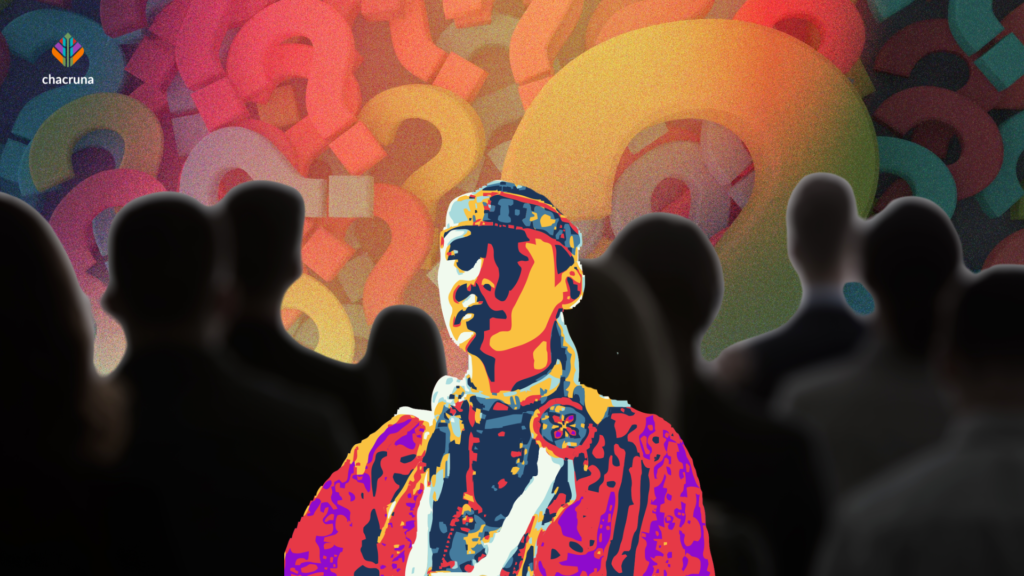
Art by Fernanda Cervantes.
References
Dasgupta, A., Williams, M. T., Feng, R., & Faber, S. (2025). Canada nice (living in glass houses): A comparative study of Canada and the United States on the prevalence and correlates of racial microaggressions. Canadian Journal of Behavioural Science. Advance online. https://doi.org/10.1037/cbs0000480
Faber, S., Kavanagh, K., Stewart, S., & Williams, M. T. (in press). The trauma of invisibility: Racial microaggressions and psychological distress among Indigenous peoples in Canada. American Psychologist. https://doi.org/10.1037/amp0001775
Strauss, D., Gran-Ruaz, S., Osman, M., Williams, M., & Faber, S. (2023). Racism and censorship in the editorial and peer review process. Frontiers in Psychology: Cultural Psychology, 14, (1120938), 1–16. https://doi.org/10.3389/fpsyg.2023.1120938

Help us celebrate our 10th anniversary! Buy our anniversary t-shirt today!