Review of: LEITE, Marcelo. The Psychedelic Science of the Jurema Tree. Springer Nature Switzerland, 2026. 202 pp. (Copernicus Books). DOI: 10.1007/978-3-032-22705-8.
In recent years, Catimbó-Jurema, Sagrada Jurema, or simply Jurema, has gained increasing visibility in academic research and the broader public imagination. This interest extends beyond its religious dimension. Jurema has also become a site of inquiry for different fields of knowledge, raising questions related to history, anthropology, pharmacology, psychology, medicine, and the study of consciousness and altered states of perception. Yet something precedes and, at the same time, exceeds scientific interest: Jurema constitutes a complex universe of knowledge, practices, memories, and relationships that, for centuries, remained rooted primarily in Indigenous territories and traditional Afro-Brazilian religious communities, as I sought to discuss in O reino dos mestres (Assunção, 2006). More than an object of investigation, however, Jurema was already a science for those who, across generations, learned to know it, worship it, use it, and establish relationships of knowledge, care, and belonging with it.
“More than an object of investigation, Jurema was already a science for those who, across generations, learned to know it, worship it, use it, and establish relationships of knowledge, care, and belonging with it.”
What we have witnessed more recently is the movement of this universe into other circuits of circulation. Jurema has crossed the boundaries of the spaces in which it was historically practiced and transmitted, reaching books, universities, the media, and digital networks. The media coverage of Jurema in the series Êxtase Ritos Sagrados, broadcast by the television program Fantástico (TV Globo, 2005), is one of the most significant examples of this context. The religious practice thus became better known and more accessible to diverse audiences, but it also became increasingly subject to new interpretations, forms of appropriation, and disputes over its meanings and modes of representation.
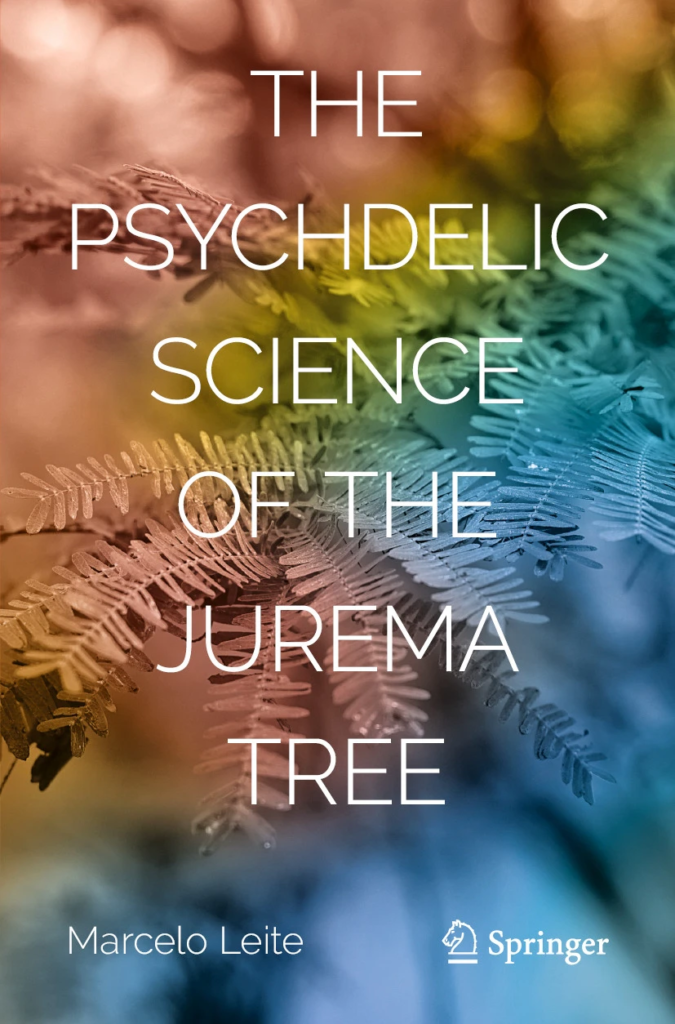
It is within this context that Marcelo Leite’s The Psychedelic Science of the Jurema Tree (Springer Nature, 2026), originally published in Brazil under the title A ciência encantada de Jurema (São Paulo: Fósforo, 2025), takes its place. The book participates in a particularly significant moment, in which knowledge associated with Jurema has begun to engage more explicitly with contemporary science, especially research on psychoactive substances, altered states of consciousness, and the therapeutic potential of psychedelics. The book’s movement is therefore twofold. On the one hand, it follows science in its attempt to understand the effects and therapeutic possibilities of psychedelic substances. On the other, it traces Jurema’s long historical, religious, and cultural trajectory. These two movements converge, but they are not interchangeable. I believe that it is precisely in this difference that the book’s richness lies.
It is no coincidence that the narrative begins, significantly, in the plant’s own territory. The account of the collection of black jurema (Mimosa tenuiflora) on a farm in Brazil’s northeastern semi-arid region, accompanied by one of the researchers from the Brain Institute at the Federal University of Rio Grande do Norte (UFRN), whose team is involved in experiments using inhaled DMT (N,N-dimethyltryptamine), a substance found in jurema, to treat depression, functions as a kind of narrative portal. Entry into the world of Jurema does not occur through the abstraction of a concept, but through contact with living matter, the territory, the plant, and the people who are part of its history. This encounter sets in motion the author’s journey through different Jurema territories, including Alhandra, in the state of Paraíba, and locations in Rio Grande do Norte, Pernambuco, Bahia, Minas Gerais, and São Paulo, combining interviews, observation, historical research, and personal experiences.
Throughout this journey, science and experience, bibliography and oral tradition, laboratory and terreiro, researchers and Indigenous communities cease to occupy rigidly separate positions. The book is constructed precisely through these intersections. Encounters with researchers, Indigenous communities, and religious practitioners, together with the bibliographical references mobilized by the author, form a multifaceted cartography of Jurema, in which different temporalities and regimes of knowledge overlap. The history of the plant meets the history of the peoples who have used and continue to use it; contemporary scientific research encounters religious practices transmitted across generations; and the author’s individual experience becomes intertwined with broader historical processes of resistance.
“Resistance appears not merely as a reaction to external violence; it manifests itself in the very capacity to keep alive particular ways of knowing, worshipping, narrating, and relating to the plant, the territory, the ancestors, and the world.”
It is also through this perspective that Jurema can be understood as a history of resistance. Its trajectory cannot be separated from the colonial processes of violence, territorial dispossession, religious persecution, and the devaluation of Indigenous and Afro-Brazilian knowledge systems. To speak of Jurema practitioners is also to speak of individuals and communities who have preserved knowledge under adverse historical conditions, making the transmission of knowledge a practice of continuity and resistance. Resistance appears not merely as a reaction to external violence; it manifests itself in the very capacity to keep alive particular ways of knowing, worshipping, narrating, and relating to the plant, the territory, the ancestors, and the world.
This perspective runs through the different themes that structure the book: the origins and history of Jurema and Catimbó; experiences of Indigenous resistance; the trajectories of Jurema practitioners; the encounters and intersections between Catimbó and Umbanda; contemporary experiences with juremahuasca; and, finally, new forms of expression associated with cosmopolitical neoshamanism. More than a thematic sequence, these chapters seem to offer different entry points into the same universe, in which tradition and contemporaneity do not exclude one another but instead remain in tension, transform, and sometimes reinvent one another.
Discover the Indigenous Reciprocity Initiative of the Americas
It is worth remembering that Jurema refers to a set of religious traditions of Indigenous origin that developed primarily in parts of northeastern Brazil. It is deeply connected to the spiritual knowledge and practices of the region’s Indigenous peoples and, throughout its history, has incorporated elements from different cultural and religious traditions, particularly African traditions and popular Catholicism, forming a diverse array of Jurema practices and lineages.
The jurema plant holds symbolic, spiritual, and ritual significance. It is understood as a link to the spiritual world and to the so-called Masters and Mistresses of Jurema (Mestres e Mestras da Jurema), entities or spirits that play an important role in religious practices. Figures known as Caboclos also appear, alongside other entities whose presence depends on the tradition being practiced. Rituals may involve songs, prayers, musical instruments, beverages, and plant materials, always according to the customs of each community. Jurema contains many mysteries that science cannot even imagine, or, as one of Leite’s interlocutors puts it, “both the drink and the ritual act are what guide you.”
Marcelo Leite’s book traverses a kind of historical thread, as I have sought to emphasize, woven through detailed accounts of Jurema and marked by the historical encounter between Indigenous, African, and other forms of Brazilian religiosity. Within this history, the “reverence before the mysteries” exceeds what the author’s rationalism can fully grasp. Nevertheless, without abandoning either affect or reason, the author leads us toward contemporary questions by examining Jurema in the context of cosmopolitan neoshamanism, where it is reinterpreted in urban settings, often in dialogue with ayahuasca, alternative spiritualities, and discourses of self-knowledge.
One of these practices, better known as juremahuasca, is a preparation of a ritual and spiritual nature that emerged from the encounter between traditions associated with Jurema and knowledge related to ayahuasca. Its origins are primarily linked to more recent religious and spiritual movements, in which different groups began experimenting with connections between the Jurema tradition and the ritual use of beverages regarded as entheogenic, as the author carefully describes and documents. I have been following the work of two religious leaders, Mãe Kelly and Pai José Roberto, who come from the Umbanda tradition and, upon founding C.E.U. das Sagradas Medicinas (@ceu_sagradasmedicinas) in the Bom Pastor neighborhood of Natal, deepened their Jurema practices through knowledge associated with ayahuasca, particularly in their work with those who are seeking transcendence and relief. Their experience suggests that there is no single formula for ritualizing these experiences; rather, each practice is shaped by highly particular lived experiences.
From a historical and anthropological perspective, juremahuasca can be understood as part of a broader process of transformation and dialogue between Brazilian religious traditions. It demonstrates how spiritual practices can change over time, developing new forms of expression without necessarily leading to the disappearance of older traditions. Here, I refer particularly to the encounter between Catimbó-Jurema and Umbanda in northeastern Brazil during the 1950s and 1960s, a subject of my own research. Persecuted by the repressive forces of the time, practitioners resorted to secrecy, performing their rituals out of sight, singing softly and without drums. The spread of Umbanda as a model of religious organization through federations, strongly encouraged by the ideological policies of the Brazilian state at the time, made it possible for different traditions, such as Catimbó-Jurema, to find spaces for inclusion and continuity. Within these contexts, Jurema and Umbanda practitioners knew precisely when each of their ritual practices began and ended. These movements of circulation and encounter continue today, as illustrated by the contemporary movement of Jurema practitioners toward Afro-Brazilian religious practices in the country’s Southeast.
Join us at Psychedelic Culture 2027: Beyond Consensus, March 11-13, 2027 in San Francisco. Early Bird Tickets are on Sale Now!
Neoshamanism is a relatively recent phenomenon that brings together elements from different Indigenous traditions, alternative spiritualities, meditative practices, and contemporary discourses on the expansion of consciousness. The relationship between Jurema and cosmopolitan neoshamanism can be understood primarily through processes of appropriation, reinterpretation, and religious exchange, rather than as an identity between the two phenomena. Jurema is presented as a tradition of spiritual knowledge rooted in Indigenous worldviews, particularly through concepts such as the sacred tree or plant, the Masters and Mistresses, the enchanted beings, spiritual worlds, and healing rituals. However, when these elements are removed from their historical and community contexts and reinterpreted to meet the expectations of urban and transnational audiences, they may acquire new meanings and functions, moving away from the ways in which they are experienced and transmitted by the communities from which they originate.
“The point is not to place science and tradition on the same plane, but to recognize that modern science is not the only historically produced way of questioning the world.”
It is at this point that the approach to enchanted science proposed by the book raises an important warning about the transmission and circulation of this knowledge. The discussion involves fundamental questions, including the relationships established with communities of origin, respect for the cultural contexts in which this knowledge was produced and preserved, recognition of Indigenous sources and knowledge holders, and the ethical limits governing the circulation of knowledge considered sacred. It is also necessary to critically examine situations in which elements belonging to specific traditions are removed from their contexts and transformed into products, services, or consumer experiences.
I believe this is the greatest merit of The Psychedelic Science of the Jurema Tree: bringing to public attention the need to envision a more horizontal dialogue between knowledge systems, in which different forms of knowledge can encounter one another without that encounter necessarily entailing the elimination of either. The point is not to place science and tradition on the same plane, but to recognize that modern science is not the only historically produced way of questioning the world.
Help us celebrate our 10th anniversary! Buy our anniversary t-shirt today!