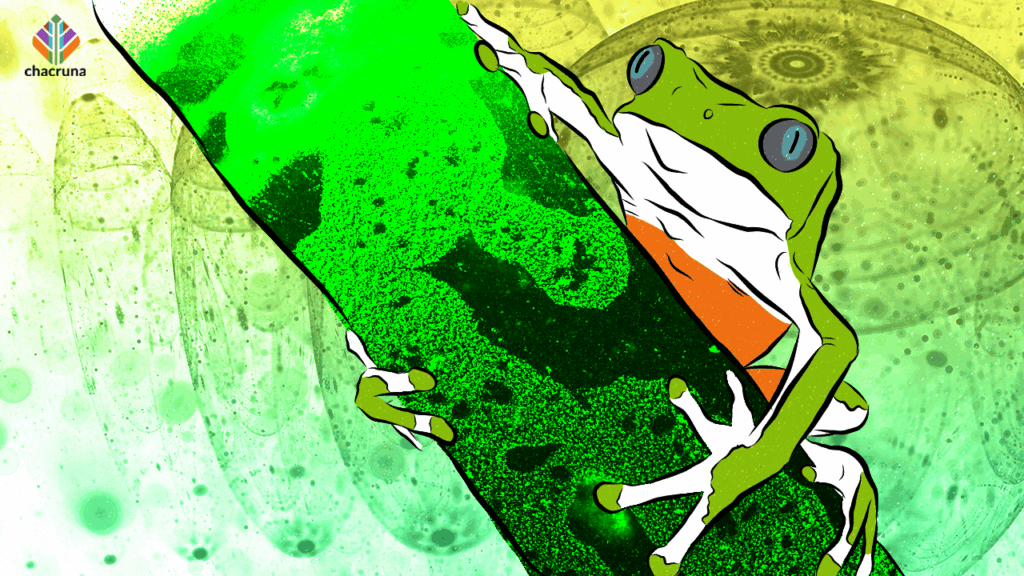
The Amazonian native practice of rubbing the exudate of some species of frog—mainly Phyllomedusa bicolor, known as kambo—into skin scarifications, is well known to both Indigenous practitioners and researchers. The primary goal of this practice amongst Indigenous peoples is traditionally related to the improvement of hunting skills, and has more recently been adapted to urban uses by non-Indigenous actors, especially those connected to ayahuasca religions and neo-shamanic networks.
A text by the French missionary Constant Tastevin, dated 1925, is commonly cited by researchers as the oldest written document attesting to the practice of kambo. This document concerns ethnic groups who live in the border area between Peru and Brazil. My research has now led to the identification of even older documents—the earliest dating back to 1881—regarding a different geographic area, the Guyanas.
A text by the French missionary Constant Tastevin, dated 1925, is commonly cited by researchers as the oldest written document attesting to the practice of kambo … My research has now led to the identification of even older documents—the earliest dating back to 1881.
The cunaua frog
In 1881, the English missionary Charles Daniel Dance reported for the British Guyana a practice to improve hunting skills called maklar. This practice consisted of hunting a particular kind of toad, called cunaua, with yellow stripes on its legs; the document describes that the hunter would “[scratch] his wrist with the caudal part of a scorpion to ensue precision in darting the arrow from the bow, and cut his arms and legs with the flakes of a broken bottle, he rubs the back of the toad over his wounds. The Indian believes that he is thus primed for hunting, and that the game will not run away from him.”
This description suggests the practice of injecting kambo; although Dance does not refer to the extraction of the toad’s secretion but rather speaks of rubbing the animal directly onto the hunter’s skin wounds. Furthermore, Dance speaks of a toad, not a frog; however, it is highly probable that the batrachian he is describing is a frog, as the presence of yellow stripes on its legs would suggest. Another element in the excerpt consistent with the practice of kambo is the use of the batrachian to improve aiming skills during the hunt.
Dance also collected a tale, the “Story of Cunaua,” which associated hunting skill with the cunaua frog. It tells of a young man named Cunaua who was extremely skilled at hunting, a skill so consistent that it began to arouse the curiosity of the community, including his wife. One day, after much insistence, the hunter took his wife into the forest. He decided to reveal to her the reason for his infallible hunting technique, on the condition that she would not reveal it to others, or he would abandon her and go live alone in the forest. He then shot an arrow into the air and told his wife to observe where it landed. She saw that the arrow had landed on a wiri-bichiri (a type of deer). His hunting secret, therefore, was to shoot an arrow into the air without aiming it at any game, as it would hit one anyway. After this incident, the woman had difficulty keeping the secret and eventually revealed it to some neighbors. As a consequence of this betrayal, Cunaua transformed into the frog of the same name and disappeared into the forest.
The transformation of the Cunaua man into a frog is, in fact, an identification of the frog with a human, a theme hinted at in other mythological contexts. In 1936, Gillin reported a tale of the Caribs living along the Barama River in Guyana, where a large frog called konowaru transformed into a man and married a woman, but at a certain point transformed back into a frog and returned to live among the trees. It is interesting to note how this tale also features the theme of the hunting skill: “One day he met a man who had no luck in his hunting. He washed the man’s skin with urine and gave the man power to hunt.” In this case, it is not the skin exudate of the frog-man, but its urine that provides hunting skill through contact with the hunter’s skin.
More recently, Bia Labate collected the testimony of a Kaxinawá, according to whom “the kampu was a pajé who died and became a frog.”
The theme of launching an arrow into the air in any direction and still hitting the game is also present in a tale of the Warao, also from Guyana, reported in 1915 by Walter Roth. This tale features a frog named Wau-uta, who gives his broken bow to a hunter; a bow that magically ensures that the arrows always hit the game. But in this case too, the hunter’s failure to respect the secret that it was Wau-uta who gave him his hunting ability caused it to be lost. Wau-uta is also said to have once been a woman, specifically a female shaman. Again, the theme of launching an arrow into the air is present in an Arawak tale from Guyana whose protagonist is a tree frog named Adaba. This one transforms into a man and helps some men by teaching them to hunt with the right arrows.
“Resin frog” and “scarification frog”
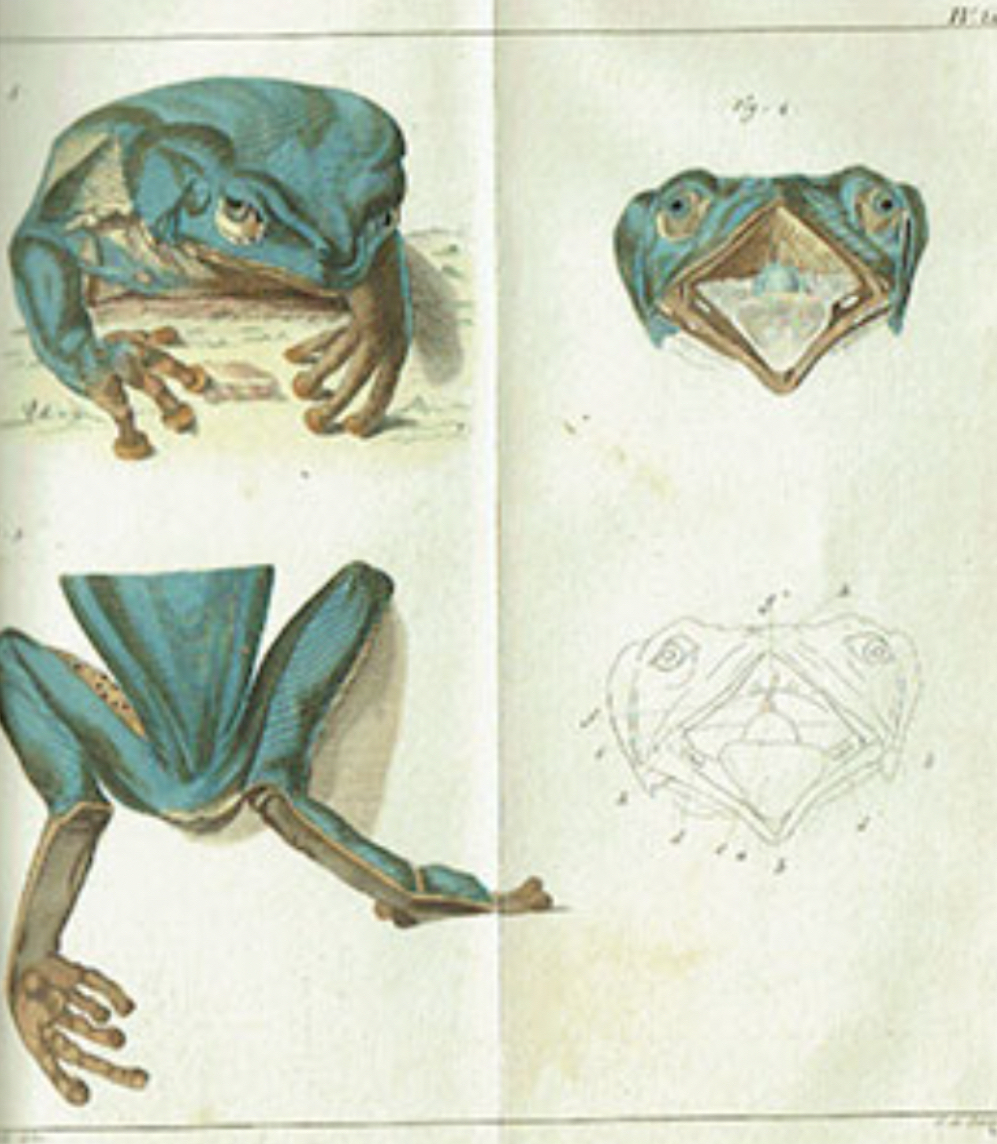
The word cunaua also refers to a natural product known in Brazil as breu cunauaru, which is a resinous substance. As reported by the Albino da Cruz’s team, many native groups of the Amazon rainforest believe it is mostly produced by a species of tree frog called canau. The frog was identified as Hyla resinifictrix (now known as Trachycephalus resinifictrix), and it has been confirmed that the frog does indeed construct a basin-shaped vivarium formed by resinous substances that ooze from the bark of certain trees.
In addition to the similarity of this frog’s name to the one described by Dance in 1881 and used for the maklar hunting technique, a couple of ethnographic reports somehow link the “resin frog” to the “scarification frog.”
In a Tupi-Guarani dictionary Ermanno Stradelli reported under the entry cunuaru-icyca that it was a resin that “is believed to come from the exudate of the Cunuarú frog,” and added that “it is attributed the virtue of turning the fisherman or hunter who encounters it into a marupiara.” Stradelli himself reported for marupiára the meaning of “happy in hunting or fishing, successful, fortunate.”
More recently, the Wayapi, a small ethnic group living in French Guyana, seek out the same resin to create facial paintings shaped like the frog’s dorsal pattern. This makes them lucky in hunting peccaries. Surprisingly, and as reported by Lescure, if they cannot obtain this resin, they resort to another technique: they rub kunawalu tadpoles on scarifications made on their arms. If these tadpoles are not found, they use the eggs of another frog called yuiso (probably Osteocephalus leprieuri), also rubbed on the scarifications.
These instances highlight that the practice of absorbing frog products through scarification appears to involve species other than those of the genus Phyllomedusa, specifically Trachycephalus resinifictrix and, perhaps, Osteocephalus leprieuri.
Discover the Indigenous Reciprocity Initiative of the Americas
The akura frog
Roth also reported the Guyana practice of applying frog exudate to skin scarifications: “on the Kaiteur savannah, a frog is rubbed on the transverse cuts made adown either side of the hunter’s chest, a different frog being used for different game.” It is curious that a specific species of frog was used for each type of game to hunt, and we do not know whether one of these corresponded to Phyllomedusa bicolor, although it is probable since the range of this species also covers this geographical area.
The same Roth described a similar practice among the Arawak natives of the Pomeroon District of Guyana, reporting the name of the frog involved and where its eggs are used: “in addition to abstention from salt and peppers, cuts are made on the arms, and the spawn of the akura frog is rubbed not only into the incisions, but also into the mouth, nose, eyes, and ears, where it is said to cause acute irritation.”
This same Indigenous group hands down a tale of how a man was never able to hunt anything in the forest. His wife then took him one day into the bush to look for the akura frog, and when they had found the nest she introduced some of the spawn into his ears, eyes, nose, and mouth. This treatment burned him terribly, and made him vomit, so much so that he was obliged to roll about in the sand to ease the pain. From then on, the man was able to hunt all kinds of game.
The krapo frog
In 1936, Gillin collected further interesting information from the Caribs of the Barama River in Guyana. It concerns one of the techniques they used to acquire a power of attraction, a “fascination” called bina, which allowed them to attract a desired object, such as game. The technique involved the capture of a certain type of tree frog called krapo. The hunter makes a series of short parallel cuts on the inner side of the arm which is used to draw the bow string. The cuts run transversely across the Branchio-radialis muscle. The hunter rubs some of the slime from the skin of the frog into these incisions, talking to the dead frog during the process and asking it for help in hunting. Next, he rubs the ashes of the krapo on the cuts. Although this technique involves the preparation of an amulet and seemingly magical operations, its similarity with the general practice of kambo is striking, and it still involves the absorption of frog secretions through skin scarification.
The Guyanas’ batrachophilia
Ultimately, these documents, dating from the late 19th and early 20th centuries, attest to the practice in the Guyanas of administering substances found in certain frog species—whether exuded from their skin or from their eggs or tadpoles—applied to cuts in the skin or directly to human facial orifices. The purpose was to improve hunters’ aiming skills. Mythological themes were passed down that these frogs had once been humans, particularly female shamans, or that they could transform into men at will, and it was these frogs that were attributed with hunting prowess. These elements are present in the kambo practices documented in modern times (an extensive article of mine on the traditional use of kampo is forthcoming, see references).
Mythological themes were passed down that these frogs had once been humans, particularly female shamans, or that they could transform into men at will, and it was these frogs that were attributed with hunting prowess.
It is worth noting that it is in the Guyanas that the highest concentration of traditional knowledge regarding various frog species has been recorded: some are used as food, others to color parrot feathers, and eggs, tadpoles, and adult frogs of other species are used in the scarification practice. This rich batrachophilia suggests that the origin of the kambo technique could potentially be found in the territories of the Guyanas.
Art by Mulinga.
References
Albino da Cruz, R. et al. (2024). “Insights into the composition of Breu Canauaru, an enigmatic medicinal ‘resin’ from Amazonia”. Revista Brasileira de Farmacognosia 34:1313–1321.
Dance, D.C. (1881). Chapters from a Guianese log-book, or the folk-lore and scenes of sea-coast and river life in British Guiana. Georgetown: The Royal Gazette Establishment.
Gillin, J. (1936). The Barama river Caribs of British Guiana. Cambridge: Peabody Museum.
Labate, B. (2005). “O pajé que virou sapo e depois promessa de remédio patenteado.” Article in www.neip.info.
Lescure, J. et al. (1980). “Les amphibiens dans l’univers Wayapi.” Journal d’Agriculture Traditionale et de Botanique Appliquée 27:247–261.
Roth, E.W. (1915). “An inquiry into the animism and folk-lore of the Guiana Indians.” Annual Report of the Bureau of American Ethnology 30:103–386.
Samorini, G. (2025). “Kampo: ethnography of a South American frog.” Antrocom Journal of Anthropology, forthcoming.
Stradelli, E. (1929). “Vocabulario da lingua geral portuguez-nheêngatú e nheêngatú-portuguez, precedidos de um esboço de Grammatica nheênga-umbuê-náua miri e seguidos de contos em lingua geral nheênghatú poranduua.” Revista do Instituto Historico e Geographico Brasileiro 104 (158):10–768.
Tastevin, C. (1925). “Le fleuve Murú. Ses habitants. Croyances et moeurs kachinahua.” La Géographie 43:403–422 + 44:14–35.