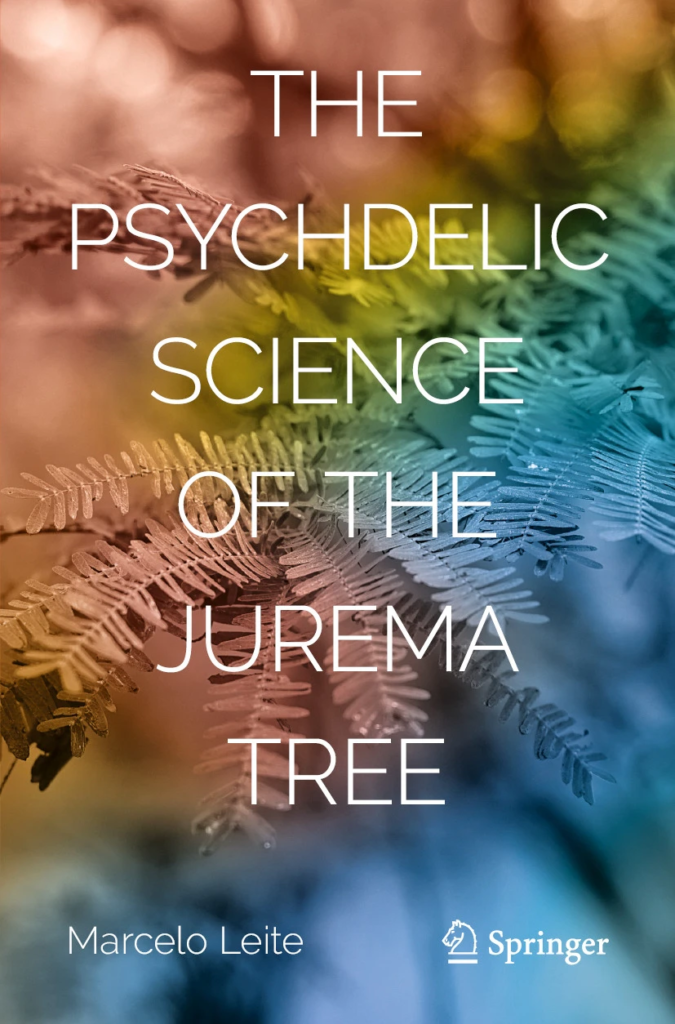
Review of: LEITE, Marcelo. The Psychedelic Science of the Jurema Tree. Springer Nature Switzerland, 2026. 202 pp. (Copernicus Books). DOI: 10.1007/978-3-032-22705-8.
The book A ciência encantada de Jurema, by Marcelo Leite, published in Portuguese in 2025 by Fósforo Editora and launched in English by Springer Nature in 2026 under the title The Psychedelic Science of the Jurema Tree, presents a journalistic investigation that transcends the boundaries of a simple narrative about a plant from the Caatinga. The work constructs a broad reflection on Jurema across various dimensions: historical, anthropological, religious, cultural, scientific, environmental, and philosophical. Its very subtitle in the Brazilian edition (“How a root from the Caatinga united Indigenous and African peoples in anti-colonial resistance and now inspires psychedelic research”) highlights the two primary themes that guide the reader: on one hand, the role of Jurema in the resistance efforts of Indigenous and Black populations against colonization; on the other, contemporary scientific interest in the plant’s psychoactive properties and the potential use of its components in mental health research.
The narrative possesses a particularly significant quality: it does not present Jurema merely as a botanical species (Mimosa tenuiflora) or a source of a psychoactive substance. Instead, it is described and analyzed as an element within a complex network of knowledge, religious practices, memories, identities, and forms of resistance. The book, therefore, challenges an exclusively biomedical view of the plant, demonstrating that what contemporary science identifies through molecules and experiments holds a much broader ancestral and spiritual dimension for certain traditional populations.
The structure of the work reflects this diversity. Following a preface by Elisa Pankararu and a prologue, Marcelo Leite organizes his investigation into nine chapters, covering a wide range of topics: from scientific research on Jurema-preta to the history of Catimbó, the resistance of Indigenous peoples in Northeast Brazil, the connections between Jurema Sagrada and Umbanda, the phenomenon known as “neo-shamanism,” contemporary psychedelic experiences, and the philosophical reflections sparked by the author’s engagement with various forms of knowledge. The table of contents illustrates this breadth, featuring chapters such as “The Goddess Jurema and the Devil of Science Against the Dragon of Anxiety,” “The Origin of Catimbó in Alhandra, a Former Colonial Settlement,” “The Power of Jurema in Indigenous Resistance in the Northeast,” and “The Sacred Jurema at the Crossroads of Catimbó and Umbanda.”
By choosing Jurema as his subject, the author is able to explore a central question that runs throughout the work: who has the authority to define what constitutes knowledge? This question becomes particularly significant when Western academic science and Indigenous cosmologies are brought into contact, revealing that the book does not merely propose replacing one form of knowledge with another. Instead, it invites the reader to recognize that different societies may develop distinct relationships with nature, the body, spirituality, and various healing processes. In this sense, The Psychedelic Science of the Jurema Tree can be understood as a work of science journalism, but also as a travelogue, a historical and anthropological inquiry, and, above all, an exercise in intellectual self-criticism. The author does not remain entirely detached from his subject. Throughout the investigation, his own conceptions regarding science, spirituality, journalism, and knowledge undergo a transformation. He acknowledges that his engagement with the peoples and rituals of Jurema fostered a more open-minded stance toward Indigenous systems of knowledge, while simultaneously leading him to take a more critical view of certain attitudes held by biomedical researchers.
In light of the above, it is evident that Marcelo Leite constructs his narrative based on his own experience as a journalist specializing in science. His interest in Jurema initially arose from his contact with researchers involved in the so-called “psychedelic renaissance.” In the prologue, the author explains that he first encountered the subject in late 2021, following a meeting with neuroscientist Dráulio Barros de Araújo, from the Brain Institute at the Federal University of Rio Grande do Norte (UFRN is the acronym in Portuguese). Through this interaction, Leite realized that Jurema could be investigated simultaneously as a scientific subject and as a piece of cultural and religious heritage.
Discover the Indigenous Reciprocity Initiative of the Americas
From a neuroscience perspective, the plant Mimosa tenuiflora, known as jurema-preta (black jurema), attracted interest due to the presence of DMT, a psychoactive substance already being studied in the context of depression and other disorders. The researcher mentioned by Leite was studying the substance, seeking to understand both its potential therapeutic effects and its biological function within the plant itself. This starting point is significant because it prevents the book from being merely a description of religious practices. The author’s initial inquiry is linked to the contemporary development of psychedelic science.
However, as his research progresses, he realizes that investigating the DMT molecule without delving into the history of religious Jurema would mean stripping the subject of its cultural context. This insight is one of the work’s primary strengths. The author refuses to let the plant be reduced to a mere pharmacological raw material. Jurema has a historical trajectory that predates its entry into laboratories, and its relationship with Indigenous peoples and Afro-Indigenous religions cannot be understood solely through its chemical composition.
Marcelo Leite himself describes the book as the result of three years of geographical, psychedelic, and philosophical forays. His journey takes him from laboratories and biomedical research to terreiros (ceremonial yards), villages, Indigenous communities, and neo-shamanic Spaces, a range of diverse experiences that shape the very form of the work. A reading of the chapters reveals that one of the book’s central aims is to move beyond a narrow view of Jurema as merely a psychoactive plant.
In the preface, Elisa Pankararu presents Jurema as part of a cultural experience encompassing various forms of healing, communication, and the transmission of knowledge. For her, the verb juremar relates to the act of communicating with the sacred, with Jurema understood within distinct cultural and spiritual contexts. This contribution in the preface is essential, as it introduces an Indigenous perspective even before the journalist’s own narrative begins. Elisa Pankararu notes that, for her people, certain practices involving Jurema are kept secret and take place only at specific times. This observation is particularly relevant for a critical reading of the book, as it highlights that not all knowledge is publicly accessible and that certain practices cannot be grasped through external observation alone. Thus, Jurema emerges as an element of belonging, a tree deeply connected to memory, ancestry, healing, and identity. Elisa Pankararu notes that, since childhood, she received teachings from her elders associated with the tree, including knowledge regarding teas, ritual baths, and sacred objects.
“How can a dialogue be established between different epistemologies without reducing one to the criteria of the other?”
This perspective significantly broadens the meaning of the word “science.” The book employs the term in a deliberately provocative way. Rather than defining science solely as knowledge produced within universities, laboratories, and formal institutions, the narrative asks whether wisdom passed down through generations might also be considered a legitimate form of knowledge. This is a crucial question, as it challenges the very history of Western science. For centuries, Indigenous knowledge was dismissed as superstition, magic, or ignorance. Yet, many practices involving plants, natural environments, and healing were developed by peoples who maintained an exceptionally sophisticated level of observation regarding their own territories. The work does not claim that traditional knowledge and scientific knowledge are identical; rather, its most compelling critique lies in questioning the historically and culturally constructed hierarchy between them. The central issue becomes: how can a dialogue be established between different epistemologies without reducing one to the criteria of the other?
In the second chapter, drawing upon early research that linked the jurema tree to the Catimbó ritual practice in Northeastern Brazil, Leite explores the significance of Alhandra, a town in the state of Paraíba. The author visits the region to map the historical trajectory of the Jurema tradition, demonstrating that Alhandra emerged as a key hub for this religious practice, which later came to be known as Jurema Sagrada (Sacred Jurema). Thus, the study reveals that the history of Catimbó is the result of a long process of cultural formation. While Alhandra became a central reference point for the tradition, the author clarifies that the phenomenon’s origins go back much further, as evidenced by records from the 17th and 18th centuries documenting the ritual use of Jurema in connection with tobacco, pipes, ceremonial songs, and the maracá (rattle).
The information mentioned is relevant because it prevents a simplistic interpretation, one that would suggest Jurema emerged only recently as an organized religion. In reality, the book demonstrates the existence of successive historical layers. The Jurema tradition has undergone processes of transformation and the incorporation of various cultural elements. While an Indigenous presence forms one of its foundations, the tradition later encountered African and European elements. Thus, Jurema is presented as the result of historical encounters, conflicts, and adaptations. Alhandra is also significant because it reveals the extent of religious persecution; practices associated with Catimbó were classified as witchcraft and faced repression from both religious and police institutions.
The author observes that the term “catimbozeiro” has acquired a pejorative connotation in certain regions, contributing to the marginalization of the tradition. A critical analysis of this aspect reveals that the history of religion in Brazil cannot be separated from the history of violence. Repression did not merely target specific beliefs; it also affected communities, identities, and modes of cultural transmission. In this sense, the adoption or increasing use of the term “Jurema Sagrada” (Sacred Jurema) in certain contexts can be understood as a strategy for asserting identity. This terminological shift does not erase the history of Catimbó; rather, it demonstrates how the groups themselves reshape their identity in the face of prejudice.
The third chapter addresses another theme of great significance both to the indigenist movement in Brazil and to anthropological studies on ethnicity, namely, the role of Jurema as an element of Indigenous resistance. Marcelo Leite travels to various locations in the Northeast, engaging with the Potiguara and Fulni-ô peoples. His research shows that Jurema cannot be understood apart from the history of the Indigenous peoples of the Northeast. The author notes that colonial repression sought to control not only territories but also the symbolic practices and knowledge systems of the original inhabitants. The Inquisition, the Portuguese Crown, the Empire, and, later, police institutions all appear in the narrative as agents of various forms of repression.
“Resistance … did not manifest solely through physical confrontation; secrecy also served as a mechanism for cultural preservation.”
Resistance, however, did not manifest solely through physical confrontation; secrecy also served as a mechanism for cultural preservation. By restricting certain practices to members of their own communities, these groups were able to safeguard their knowledge from a society that might otherwise have used it to persecute or destroy these traditions. This interpretation is crucial for grasping the true significance of Jurema: it is not merely a religion or a plant used in rituals, but a vital part of a history of cultural survival. Thus, the book demonstrates that the link between Jurema and resistance is not confined to the past. Indigenous rituals, chants, dances, and identities in the present day demonstrate that cultural resistance is an enduring phenomenon. The Festa da Ciência do Amaro (Amaro’s Science Festival), for instance, serves as a space where the Indigenous people Pankararé and various entities linked to the Jurema tradition engage in manifestations that weave together spirituality, ancestry, and identity. This dimension highlights that culture is not static; it evolves without necessarily losing its recognizability to those who practice it.
Join us at Psychedelic Culture 2027: Beyond Consensus, March 11-13, 2027 in San Francisco. Early Bird Tickets are on Sale Now!
The discussion regarding the relationship between Jurema Sagrada, Catimbó, and Umbanda, the subject of the fourth chapter, reveals the author’s keen attention to the complex boundaries of classification. Rather than confining the issue to rigid divisions, often constructed by the practitioners themselves, who may fear the appropriation of their knowledge, Leite demonstrates the potential for fluidity between traditions that are, ultimately, historical and variable. In this sense, the work acknowledges processes of syncretism involving Indigenous, African, European, and Spiritist elements. Since the colonial era, enslaved Indigenous peoples and Africans established contact within various social spheres, facilitating the circulation and transformation of religious practices. Subsequently, Catimbó also absorbed influences from Kardecist Spiritism and Umbanda. Thus, Leite’s assertion that “Jurema is not Umbanda, except when it is” provocatively encapsulates this complexity. This statement should not be interpreted as a logical contradiction, but rather as an acknowledgment that religious identities do not necessarily function as rigid categories. In other words, a terreiro (cerimonial yard) might incorporate elements of Umbanda while still identifying itself as a space for Jurema, whereas another might preserve characteristics closer to traditional Catimbó.
This plasticity constitutes one of the tradition’s core strengths. Jurema has survived precisely because it has managed to adapt to different historical contexts. However, this process also prompts a critical reflection: to what extent does the incorporation of external elements strengthen the tradition, and at what point might it lead to the erasure of its Indigenous characteristics? The book does not offer a definitive answer, but it allows the reader to perceive this tension. In fact, this is one of the work’s virtues: it avoids reducing Jurema to a homogeneous category. On the contrary, it highlights its internal differences and its transformations. Regarding the scientific dimension—explored in the fifth and sixth chapters, one can discern the depth of the research conducted by Leite, which, however, makes no attempt to establish hierarchical relationships between Science (the body of academic knowledge) and science (as understood within Amerindian cosmologies).
“While modern scientific knowledge can reveal important biochemical mechanisms, this does not necessarily mean it has uncovered the meaning of the plant itself.”
According to the author, contemporary research on Jurema is primarily linked to the presence of the molecule DMT in Mimosa tenuiflora, an observation indebted to the experiments of Oswaldo Gonçalves de Lima, a chemist from the Northeast state of Pernambuco who isolated the substance from jurema-preta in the 1940s and named it “nigerine.” This episode establishes a historical link between Indigenous knowledge of the plant and the subsequent scientific investigation of its components. This passage also invites a critical reflection on the very workings of academic science. Indigenous peoples were already using the plant long before its chemical composition was identified by researchers. Science, therefore, did not “discover” the cultural existence of Jurema; rather, it identified and isolated a substance present in a plant that already held significance for various communities. This contrast is one of the most compelling elements of the work. While modern scientific knowledge can reveal important biochemical mechanisms, this does not necessarily mean it has uncovered the meaning of the plant itself. The current interest in DMT is also tied to the so-called “psychedelic renaissance.” Researchers have begun investigating psychedelic substances in search of potential therapeutic applications, including for cases of depression that are resistant to conventional treatments.
In the book, Leite follows experiments conducted at the Brain Institute of the Federal University of Rio Grande do Norte. The author presents hypotheses concerning neuroplasticity, inflammatory processes, and the possibility that the psychedelic experience might help break patterns of negative thinking. However, a critical reading reveals that the work itself demonstrates just how much these possibilities still depend on rigorous scientific investigation. This caution is important, as it prevents the book from framing Jurema as a supposed “miracle cure.” The approach is more nuanced: there are promising results and hypotheses, but there are also questions that remain unanswered.
Furthermore, regarding the subject of psychoactive substances, a notable feature of the book is that Marcelo Leite recounts his own personal experiences, first with Ayahuasca, and later with Jurema. This choice can be considered one of the work’s strengths, or, to a hasty reader, one of its weaknesses. On one hand, personal experience allows the journalist to gain a more concrete understanding of the subject he is investigating; he does not remain merely an external observer. His experience with DMT is part of the process that transforms his relationship with the topic. On the other hand, there is a risk that this subjective experience might be interpreted as scientific evidence. The author’s merit lies precisely in his recognition of this distinction and his willingness to discuss the limits of objectivity itself. In doing so, he challenges the notion that science can be entirely detached from the worldviews of those who conduct it. When discussing psychedelic science, he notes that some scholars end up incorporating metaphysical concepts into their interpretation of altered states of consciousness. In this discussion, explored further in the postscript, the author draws upon his own experience within the psychedelic realm to reflect on his craft as a journalist, proposing three principles that should guide the work of any reporter or investigator: seek the truth, act independently, and minimize harm. This concern is particularly significant when it comes to traditional peoples. A piece of journalism might shed light on a specific practice while, at the same time, inadvertently contributing to its exposure, appropriation, or exploitation. In other words, while disseminating knowledge can help combat prejudice and foster greater awareness of certain cultures, it may also strip groups of control over what they choose, or do not choose, to make public. In short, it is a complex and highly challenging dilemma.
Art by Mulinga.
Help us celebrate our 10th anniversary! Buy our anniversary t-shirt today!