Michel Foucault, whose 100th birthday was celebrated on October 15th, left behind an established body of historical and philosophical work. Yet, his searing intellect—so prominent in other eras—is seldomly associated with a singular episode in his biography: a weekend in May 1975 when he took LSD in the California desert and experienced a transformative moment. Last April, I set out to find echoes of that experience during a two-day solo road trip through that otherworldly landscape.
“It was a great experience, one of the most important in my life. And I don’t mean only the Zabriskie night, but our meeting and the two days we spent together,” Foucault wrote days later. The letter appears in the book Foucault in California: A True Story – Wherein the Great French Philosopher Drops Acid in the Valley of Death by Simeon Wade.
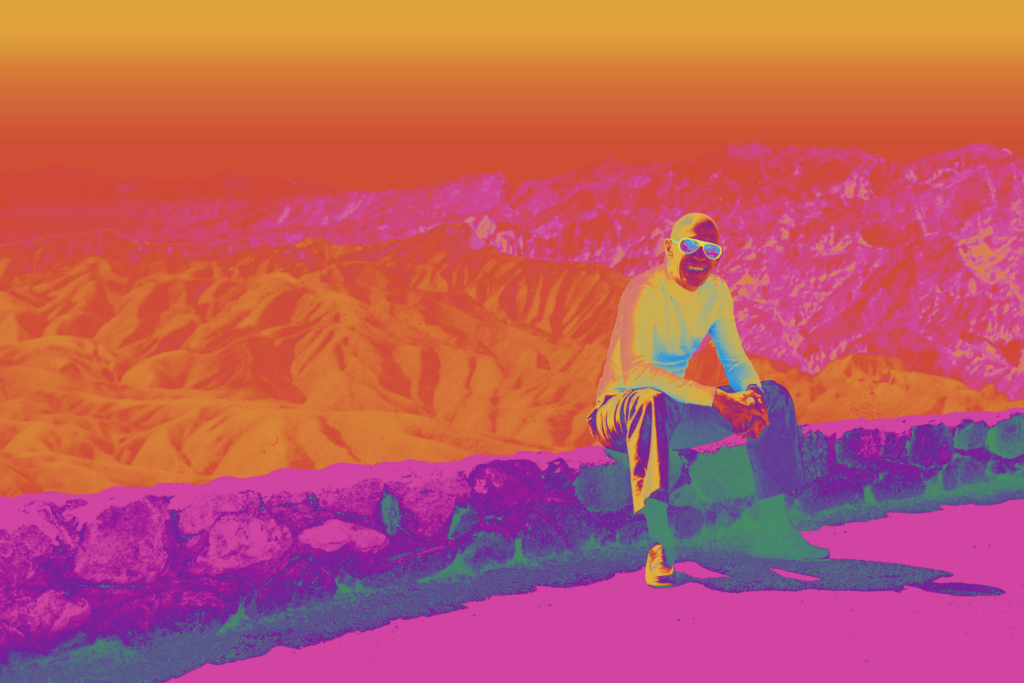
Together with Michael Stoneman, Wade hosted Foucault in Claremont—where he was teaching at a local graduate school after earning his PhD in history from Harvard University. An aficionado of the French thinker’s work, Wade experienced a delusion of grandeur and invited him to participate in an experiment—a formula consisting of Michel Foucault + Philosopher’s Stone + Death Valley + Michael Stoneman—with Wade acting as both alchemist and rapporteur. Foucault agreed.
California loomed large in the mental geography of these three psychonauts. Simeon had crossed the United States as a refugee from Harvard, spurred by the impact of Michelangelo Antonioni’s 1970 film Zabriskie Point. He had met Stoneman at a gay club, and the two remained together until Stoneman’s death in 1998.
Foucault was a visiting scholar at Berkeley and was considering moving to the state, which he viewed as a land of freedom and possibility. “What I particularly like about Brazil, and California for that matter, is that the boys are not proud or arrogant,” he told his new friends, according to Wade. “As opposed to Europe, the boys don’t strut around; they are at ease with their bodies. They are accessible. A bit like ancient Greece.”
“California would not sink, so it would not be a disaster,” in case the sate breaks off into the Pacific Ocean during an earthquake. “California would become an island. And begin floating toward China.” He added: “I now understand why people who live here when they travel abroad say they are from California rather than from America. […] California and America are not the same.”
Half a century separates that sunny optimism from the California of today—an epitome of the U.S.A. where Big Tech reigns supreme, the legacy of the counterculture has been reduced to ripped jeans and cannabis megastores, and former hippies cruise around in autonomous Waymo vehicles or head to Burning Man in their Teslas. In 1975, such naivety may have made some sense—even though the film by Antonioni (which Foucault had only seen on French television) already foreshadowed the domestication of rebellion that neoliberalism would eventually impose.
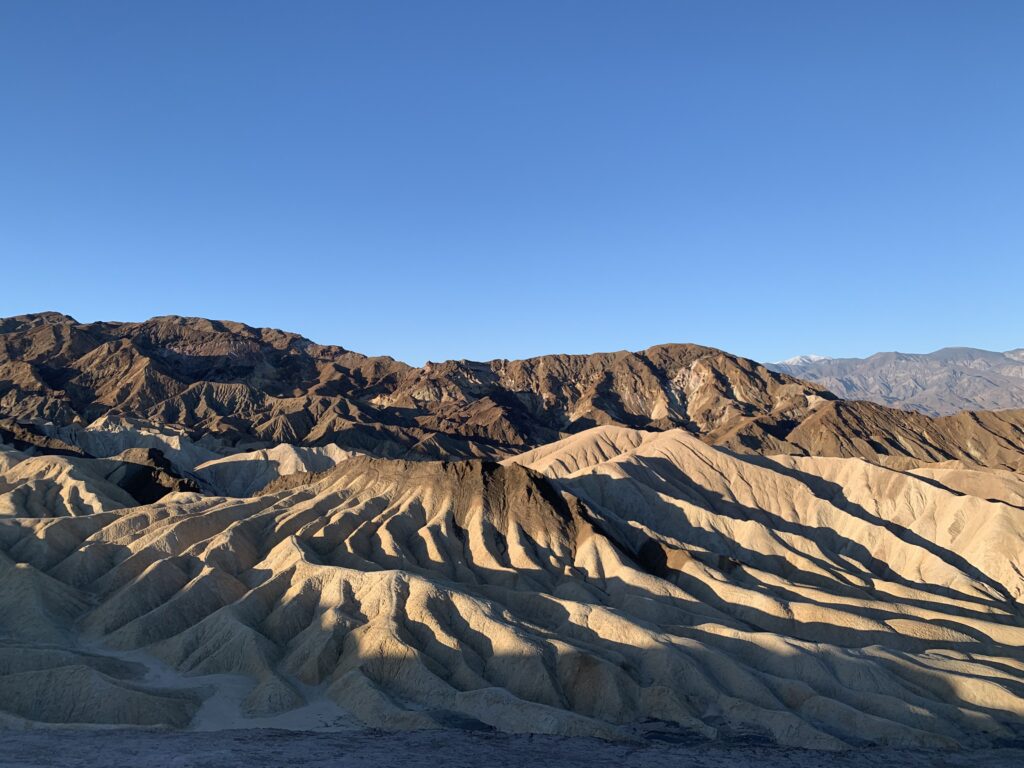
Antonioni was not the only motivation for the trio’s trip. The location had already been the site of psychedelic excursions by Wade and Stoneman—a very well-chosen scenario by them and the Italian filmmaker alike. Few places on the planet offer such expansive horizons and comparable geological eloquence. Retracing Foucault’s journey to the Death Valley—exactly 51 years after he made it—I wrote in my notebook, as a sober traveling reporter: “The desert looks like something out of a Yayoi Kusama work; tufts of vegetation dot everything that isn’t mountain or rock,” I read back. “There’s a touch of Patagonia and [the Brazilian biome] Caatinga here—that haughty dryness—yet the spaces feel even vaster. And the sky—my god, how can it harbor so many clouds? It’s no wonder Foucault chose to remain silent for part of the way; it’s enough to humble anyone, Christian or bethren.”
According to Wade’s account of his own philosophizing chatter, silence was a common reaction from the French thinker who, four years earlier, had joined the Collège de France. Trivial conversations would occasionally offer a morsel to satisfy the American’s curiosity—such as when Foucault confessed that he had attended parties in France where he was offered LSD, though his boyfriend would decline on behalf of both of them. “Perhaps he resists hallucinogens because he has a certain way of relating to his body. After all, we are our bodies!” Then, after a pause: “And something else.”
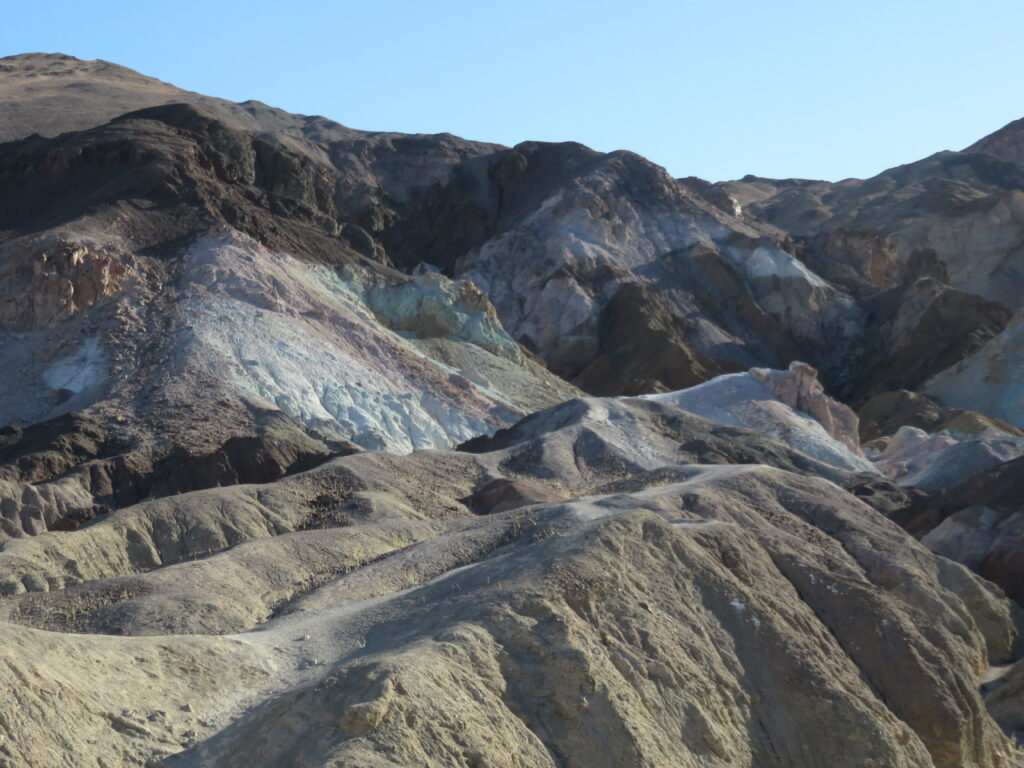
His initial impulse was to try half a dose, but the pair from California convinced him to dive headfirst into the lysergic experience. At some point along Artist’s Palette—a one-way loop winding past multicolored escarpments, accented by improbable shades of green—Foucault licked his fingertip, pressed the substance against his lower teeth, and asked how long it would take to kick in. Stoneman explained that they would speed things up with some marijuana and Grand Marnier, the French liqueur.
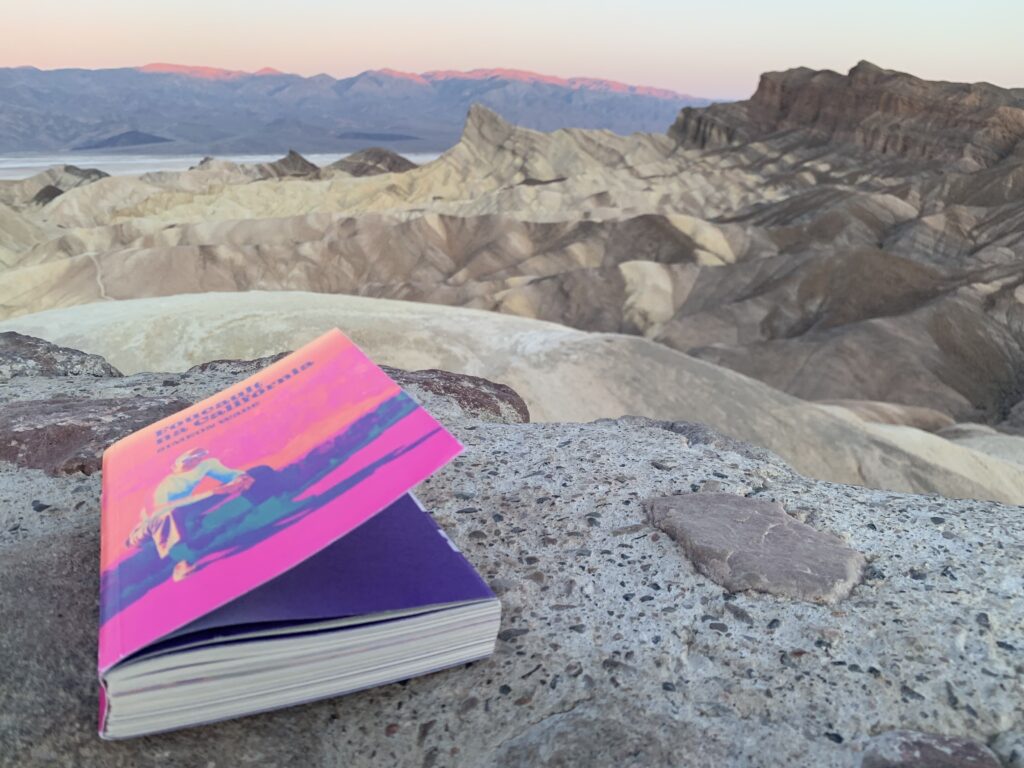
From there, they moved on to Zabriskie Point—a lookout surrounded by landmarks like Telescope Peak and Manly Beacon, featuring rock formations striped by the depths of geological time, frozen dunes, and a salt flat below. This inspired Wade to compose a near-haiku: “The dry lake is but the flood forgotten.” They arrived at dusk and stayed until dawn. It was also at daybreak that I watched the sun slowly paint the peaks in shades of pink. I wasn’t alone—as I had naively imagined I might be at 6:00 a.m.—for at least two dozen vehicles already filled the parking lot. I sat down in one of the few remaining spots on the low wall and had breakfast, taking discreet sips from a small bottle of Chardonnay—the closest thing I could find to a more fitting Californian elixir.
The breeze flipped the pages of the Brazilian edition of Foucault in California with its shocking-pink cover, which featured the bald philosopher—sporting a turtleneck and thick-rimmed sunglasses, both of a striking white—settling onto that very same wall with a smile. I was reminded of the scene where the wind flipped pages of the Gospel resting atop Pope John Paul II’s coffin in St. Peter’s Square, back in another April—that of 2005.
“The sky has exploded and the stars are raining down upon me. I know this is not true, but it’s the Truth.”
Michel Foucault (on his LSD trip at Zabriskie Point)
Foucault was not the last to have an epiphany there under the influence of LSD, although the favorable scenario must have contributed to amplifying it to a point of mutation. “The sky has exploded and the stars are raining down upon me. I know this is not true, but it’s the Truth,” said the philosopher while listening to Elisabeth Schwarzkopf sing Richard Strauss’ Four Last Songs, as Wade narrates. The young man asks him if it would be possible for all of mankind to take the substance and experience something like what they experienced that night. “I wish it were possible,” Foucault replies, according to Wade wistfully. “The only thing I can compare this experience to in my life is sex with a stranger. Contact with a strange body affords an experience of the Truth similar to what I am experiencing now.”
Foucault died in 1984 with AIDS. The themes of freedom, militancy, pleasure, and death had already occupied the center of the film Zabriskie Point, which begins with a student debate in Los Angeles about whether or not to use violence against the ruling class and its police. Mark argues with radical black militants, leaves the meeting after declaring his willingness to die, buys a gun, goes to prison, leaves jail, steals a plane and flies over the desert.
Daria travels toward Phoenix to meet her boss and lover, Lee, and is also looking for a quiet place for meditation. Her old car starts to be chased by Mark with low flights. He lands, and the motorized flirtation ends with the two strangers having sex at Zabriskie Point, a scene that evolves into the surreal multiplication of couples and groups copulating, a luminous orgy on sand and rocks.
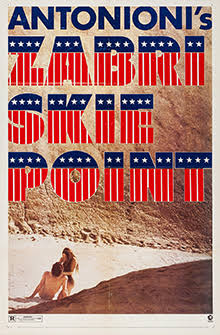
Then Mark and Daria paint the stolen plane with psychedelic motifs and phrases like “No War” and “No Words.” Daria resumes her journey, and Mark flies back to Los Angeles, where he ends up being shot by the police. Daria arrives at Lee’s mansion in Phoenix, learns of Mark’s death and leaves the house. She drives a few hundred meters and, upon getting out of the car, contemplates the mansion and witnesses (or imagines) from various angles the explosion of the property that launches into the air, in slow motion, a bunch of icons of consumerism: clothes, a TV, fruit and chicken from a fridge, a box of Kellogg’s cereal, furniture, magazines — all to the screams of Pink Floyd’s guitar in the song Come in Number 51, Your Time is up.
Amateur actors, also called Daria (Halprin) and Mark (Frechette) in real life, they were indeed lovers and took drugs together in the Fort Hill community. After being convicted of robbing a Boston bank by his radical group, Frechette died at the age of 27, in prison, from asphyxiation under the weight of a dumbbell. Halprin would still make some films, but left her acting career and became a body therapist.
Wade’s book, in contrast, deals little with the political uprising of the 1960s counterculture. The theme emerges when the Claremont professor describes Foucault’s debates with students after the conference that served as pretext for the French scholar’s visit. But it emerges obliquely, with Foucault expounding his concept of knowledge archaeology, as in excavating the mythological foundations of the system of power offered by disciplinary normalization under constant surveillance in Jeremy Bentham’s panoptic model for prisons and asylums.
“I think that our society and what we are has a deep historical dimension, and in this historical space the discursive events which have taken place centuries ago, or years ago, are very important”, responds the thinker, who describes himself as a journalist. “I’m interested in the present. I use history to understand what’s happening to us now.”
Regarding intellectual work, the philosopher uses a pyrotechnic metaphor to state that it is not enough to build “very beautiful, or useful, or funny tools,” but bombs instead: “I would like to write book-bombs,” he threw like a firecracker at the audience. “In later years, historians and others could recount that such and such a book was useful as a bomb and was beautiful as fireworks.”
The admirable flash of his thought has since then dimmed, true. It is now up to historians — or journalists — to recover what he so brightly illuminated back in 1975. The rebellion tide of the counterculture was already receding, then, to leave behind the salt desert starting to be deposited by neoliberalism, or what the British thinker Mark Fisher would call capitalist realism.
The reality principle, in an individualistic version, imposed itself on the pleasure principle, especially in the sense of collective and liberating enjoyment envisioned in the pacifist mobilization, gay pride, ecological consciousness, and the psychedelic community. This ended the emancipatory path dreamed of by Foucault under the influence of LSD and two days in the Hellenic company of Wade and Stoneman.
“I think that such meetings don’t make sense if they don’t give to everybody an intense and reciprocal pleasure and the same quietness,” he wrote to them in a letter shortly after. “What we have to do is find the way to make with the ‘principe de plaisir’ [a] ‘principe de realité’. That is, I think, an ethical and a political problem to be solved nowadays.”
The challenge remains, half a century later. Although some interpret Foucault’s “ethical turn”—which followed his time in California and led him to discard what he had already written for the continuation of his History of Sexuality in favor of a focus on the “use of pleasures” and “care of the self”—as a form of depoliticization, the collective momentum of that rising psychedelic and countercultural tide is surely something that deserves to be revived.
“Has the dream ended, or has it merely been forgotten? Is it possible to bring it back—perhaps through the promise of an ‘acid communism,’ as envisioned by Mark Fisher—or is there truly no alternative to the savage recapitalism seen under Donald Trump?“
Has the dream ended, or has it merely been forgotten? Is it possible to bring it back—perhaps through the promise of an “acid communism,” as envisioned by Mark Fisher—or is there truly no alternative to the savage recapitalism seen under Donald Trump? It does not seem like a good omen that the British author behind the blog k-punk took his own life in 2017, just one week before the new U.S. president began his first term in office.
The fact is that the 21st-century psychedelic renaissance moves in the opposite direction to that taken by the counterculture. It is, in two distinct ways, not a “renaissance” at all. The psychedelic impulse never truly vanished, it merely retreated into the underground under the prohibitionist boot of the 1970s. What has re-emerged in the 2000s is not a bright horizon of new consciousness and communal joy—reminiscent of Woodstock—but rather the containment of LSD and its ilk within the framework of individual panaceas for industrial-scale unhappiness (depression, anxiety, post-traumatic stress, substance abuse, gambling addiction). This all unfolds within the panopticon of social media, patrolled by bots that see everything from the watchtower of artificial intelligence.
In an unfinished introduction about acid communism—intended for a book he would never write—Fisher still sounded optimistic: “Despite all the mysticism and pseudo-spiritualism which has always hung over psychedelic culture, there was actually a demystificatory and materialist dimension to this,” he wrote. “Widespread experiments with consciousness promised nothing less than a democratisation of neurology itself — a newly widespread awareness of the brain’s role in producing what was experienced as reality. Those on acid trips were externalising the workings of their own brain, and potentially learning to use their brains differently.”
Death spared Fisher from seeing Donald Trump take office—not only once, but twice. He was also spared the sight of the U.S. President, flanked by Robert Kennedy Jr., Joe Rogan, and Brian Hubbard, as he signed an executive order to fast-track psychedelic research. What far right reactionaries are targeting is not psychedelic-assisted liberation nor emancipation, but rather the alleviation of mental suffering endured by veterans of their numerous imperialist wars, former combatants who otherwise might be choosing the exit door also taken by Fisher, at an apalling rate of 18 suicides per day.
Note: Marcelo Leite is a Science journalist based in São Paulo, Brazil, the author of the book The Psychedelic Science of the Jurema Tree (Springer Nature, 2026).
A version of this article was originally published in Portuguese by the Brazilian newspaper Folha de S.Paulo and can be accessed here.
Art by Michelle Velasco.