Most people in the psychedelic movement have never met a Mazatec elder, yet they speak with confidence about what my community needs. I want to change that conversation.
I am a Mazatec sociologist and historian from Barrio de la Cruz, Huautla de Jiménez, Oaxaca. I coordinate the Indigenous Reciprocity Initiative of the Americas (IRI), a program of the Chacruna Institute. The IRI is a pioneering program that partners with Indigenous communities across the Americas, supporting initiatives in their territories that strive to strengthen biocultures and the diverse elements that sustain them (Boege, 2008). These projects are led by Indigenous peoples themselves, guided by their own priorities, needs, and self-determination.
Our commitment to reciprocity, education, and collaboration drives everything we do. My work sits, therefore, at the intersection of two worlds that rarely understand each other: the global psychedelic movement and the Indigenous territories it claims to honor.
Romanticizing Us Hides Our Real Struggles
For 70 years, Huautla de Jiménez has been a reference point for anyone curious about sacred mushrooms and María Sabina (Chacruna Institute, 2025). That story is long, and it is urgent to say something plainly. The global psychedelic movement and psychedelic science exist because of knowledge that Indigenous peoples provided, voluntarily or not.
Researchers and academics have played a determining role in this process. They legitimized their own narratives through science, and often through racial, economic, and cultural superiority. Owning the narratives about Indigenous peoples and their sacred plants is one of the clearest expressions of the ego that prevails today.
The scholar Linda Tuhiwai Smith has traced how Western research itself became a tool of colonization, extracting knowledge from Indigenous peoples without consent or benefit (Smith, 2012). I see that same pattern today.
The philosopher Enrique Dussel argued that modernity did not begin with Descartes’ thinking in Europe. It began in 1492, with the conquest of the Americas. Dussel called this the “conquering self”: the logic that let Europe dominate and extract from the lands it colonized (Dussel, 1995). I think that logic is what has shaped many areas of the psychedelic field.
This raises a question: Is the call to “connect” psychedelic science with traditional knowledge itself part of the romantic narrative? Both terms tend to get flattened into neat, bounded categories ready for merging—often with a messianic edge, framed as a paradigm shift or a new science of consciousness.
Right now, there are active attempts at cultural misappropriation. People are legitimizing claims about sacred plants that Indigenous communities themselves do not recognize. Neocolonial practices intensify when they wear scientific, academic, and spiritual clothing.
Indigenous peoples continue offering their knowledge for the healing of people outside of their communities, even amid this violence. But I ask Western practitioners to question themselves. Where does the illness actually come from? Is it fair to believe a heroic dose of a sacred plant can cure everything? It is important to note the near absence of discussions about social class within the psychedelic field, and how exploitative relationships under neoliberal capitalism systematically contribute to problems such as depression and anxiety.
“We need to analyze the structural conditions that cause psycho-emotional and spiritual suffering in the Western world.”
We need to analyze the structural conditions that cause psycho-emotional and spiritual suffering in the Western world. People focus only on the suffering itself, rather than its origins, and so, unfortunately, sacred plants are used merely as palliatives. It is essential to address social justice in the field of psychedelics.
A Universe Beyond Psilocybin
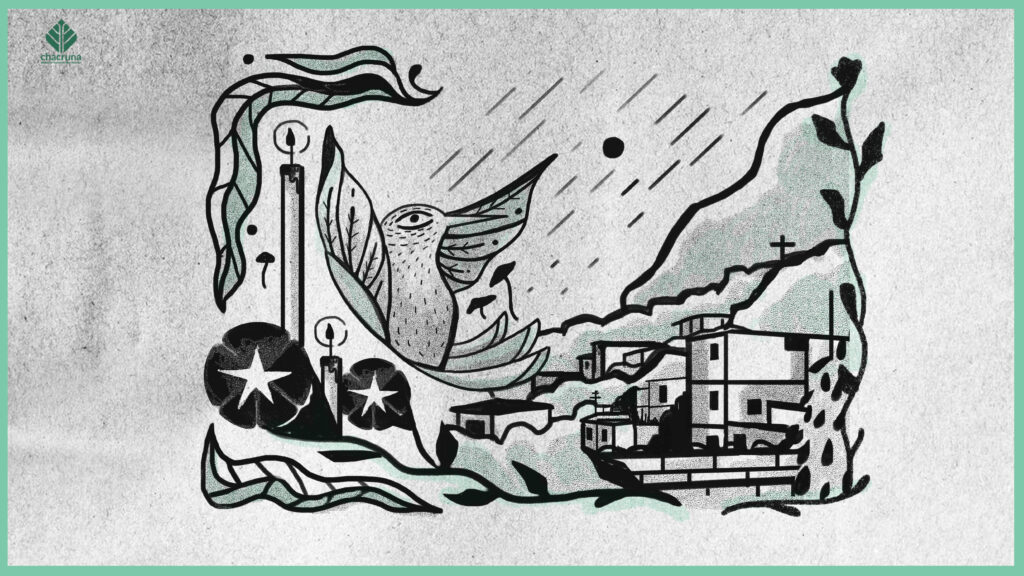
Mazatec tradition is ancestral and complex. It is a universe of sacred knowledge, and sacred mushrooms are only one part of it. Western science has reduced Mazatec bioculture to a single molecule and a sensationalist story about its discovery. This historical debt is also an open wound in the Mazatec mountains.
Many Indigenous individuals do not even know what “the psychedelic movement” is, and I am not sure that is something they need to know. Most Indigenous people are focused on meeting basic needs. They fight for food, decent housing, and protection for their families and their land. That fight for life is what allows their traditions and cultures to keep existing.
In that sense, preserving and transmitting knowledge is not a project. It is daily life. It is difficult to insist that Indigenous priorities should include “having a role” in the psychedelic scene, when survival itself is the priority.
Discover the Indigenous Reciprocity Initiative of the Americas
Breaking the Messianic Narrative
Believing that Indigenous peoples and sacred plants will “save humanity” is irresponsible. It is irresponsible precisely because we are facing urgent struggles in our own territories right now. Some white narratives claim that Indigenous people are rich in spirituality and that is why we will save humanity, but this concept prevents us from seeing the historical issues within our territories.
Consider President Trump’s 2026 executive order encouraging federal research into ibogaine, alongside a 50 million dollar investment in state-level psychedelic research (Cohen & Marks, 2026). Events like this reflect colonial processes. They bring no direct benefit to the Indigenous peoples and territories where these plants and their knowledge originate. These processes might potentially exacerbate even more the violence against sacred plants, reducing them to substances that will cure the problems of the modern world without addressing the real problem.
“Reciprocity cannot be built on romance. It must be based on an honest analysis of power dynamics within the psychedelic scene and those within Indigenous territories.”
Talking about these uncomfortable issues is necessary. It is the only way to break messianic and salvationist narratives in the psychedelic field. Reciprocity cannot be built on romance. It must be based on an honest analysis of power dynamics within the psychedelic scene and those within Indigenous territories.
Who Gets to Represent Us?
The psychedelic field is a contested space. It is shaped by disputes between non-Indigenous and Indigenous intermediaries and gatekeepers, and these roles are tied to flows of money that rarely reach Indigenous territories. There is a constant struggle to dominate the field and the narratives that emerge from it.
At the core of this field sits a constant struggle. Who gets to represent Indigenous peoples? That struggle is deeply entangled with economic interests, and Indigenous representation itself has become a contentious, biased issue.
Who has the authority to tell the story of the Mazatecs and other Indigenous peoples? The psychedelic movement grants this authority to Indigenous and non-Indigenous people who are not always committed to the biocultures to which they claim to belong. There is a cultural, symbolic, and power-based barrier that prevents many Indigenous people from engaging with wealthy psychedelic circles. Reciprocity and justice must go beyond the aspirations of any single person or organization.
I want to be clear about something else. Non-Indigenous participation in ceremony is possible (Platero, 2026). But it requires responsibility and clarity of purpose. Indigenous elders dedicate their entire lives to learning from sacred plants. In the West, becoming a “shaman” is too often treated as something quick and easy.
I also want to recognize the non-Indigenous allies who are genuinely trying to build bridges between the Global North and South. Many of them understand this is a long road. They know the goal is repairing, restoring, and preserving Indigenous cultural elements, not extracting them. In that process, Indigenous voices must lead. Goodwill from allies must never be co-opted by particular agendas, whether those agendas sit inside Indigenous communities or outside them.
What Reciprocity Looks Like in Practice
Reciprocity is not a fixed idea. As Eve Tuck and K. Wayne Yang remind us, “decolonization is not a metaphor for other things we want to do to improve our societies” (Tuck & Yang, 2012). It is an ongoing process, and it must go beyond academic theory. The Chacruna Institute seeks to shift paradigms in the psychedelic field by integrating historically marginalized communities and challenging dominant cultural narratives.
The Indigenous Reciprocity Initiative is one attempt to make that shift concrete. Launched in 2021, IRI is a pioneering program in decolonial philanthropy (Banerjee & Shriram, 2022). Our mission is to support the strengthening of their biocultures and their struggle for self-determination.
There is no formula that solves the conflicts of colonialism over Indigenous territories. But there are proposals trying to build fair relations between the Global North and Indigenous peoples, grounded in dialogue and respect for Indigenous autonomy. We need many more of these dialogues. We need protocols. We need laws that guarantee the defense of Indigenous peoples, their rights, their territories, and their ancestral knowledge.
An Invitation, not a Conclusion
I began by saying most people in this movement have never met a Mazatec elder. I will end by saying that this can change, but only on our terms, and that in itself is a challenge for us because we have to discuss the issue of legitimacy both within and outside the territory.
“If reciprocity means anything, it means Indigenous peoples leading the conversation about our own future, not being cast as its inspiration.”
The fight against attempts to monopolize the narrative about Indigenous peoples and their sacred plants is not over. Those plants and mushrooms, and those stories, do not belong to the Western world. They belong to the peoples who protected them through centuries of pressure to forget.
If reciprocity means anything, it means Indigenous peoples leading the conversation about our own future, not being cast as its inspiration.
Further Resources on Reciprocity
Chacruna’s Chronicles on Reciprocity
IRI’s Recommended Readings on Reciprocity
Note: This article was originally published in MAPS Bulletin: Volume XXXVI.
Art by Karina Alvarez.
Help us celebrate our 10th anniversary! Buy our anniversary t-shirt today!
References
Banerjee, S., & Shriram, U. (2022, September 6). Decolonising philanthropy: From conceptual apprehension to functional progress. Alliance Magazine. https://www.alliancemagazine.org/feature/decolonising-philanthropy-from-conceptual-apprehension-to-functional-progress/
Boege, E. (2008). El patrimonio biocultural de los pueblos indígenas de México: Hacia la conservación in situ de la biodiversidad y agrodiversidad en los territorios indígenas [The biocultural heritage of Mexico’s Indigenous peoples: Towards the in situ conservation of biodiversity and agrobiodiversity in indigenous territories]. Instituto Nacional de Antropología e Historia; Comisión Nacional para el Desarrollo de los Pueblos Indígenas. https://patrimoniobiocultural.com/archivos/publicaciones/libros/El_patrimonio_biocultural.pdf
Chacruna Institute. (2025, March 19). Examining the discursive role of María Sabina in modern psychedelic therapy. Chacruna Chronicles. https://chacruna.net/examining-the-discursive-role-of-maria-sabina-in-modern-psychedelic-therapy/
Cohen, I. G., & Marks, M. (2026, April 18). A new executive order on psychedelics: Q&A with I. Glenn Cohen and Mason Marks. Petrie-Flom Center. https://petrieflom.law.harvard.edu/2026/04/18/a-new-executive-order-on-psychedelics-q-a-with-i-glenn-cohen-and-mason-marks/
Dussel, E. (1995). The invention of the Americas: Eclipse of “the other” and the myth of modernity (M. D. Barber, Trans.). Continuum.
Garcia Cerqueda, O. (2014). Huautla: tierra de magia, de hongos… y hippies. 1960 – 1975 [Huautla: land of magic, mushrooms… and hippies. 1960–1975]. Benemérita Universidad Autónoma de Puebla.
Smith, L. T. (2012). Decolonizing methodologies: Research and Indigenous peoples (2nd ed.). Zed Books.
Tuck, E., & Yang, K. W. (2012). Decolonization is not a metaphor. Decolonization: Indigeneity, Education & Society, 1(1), 1–40.
Platero, L. (2026). Indigenous reciprocity amid contemporary international shamanic networks. In J. Breau & P. Gillis-Smith (Eds.), Psychedelic intersections: 2025 conference anthology. Center for the Study of World Religions, Harvard Divinity School. https://doi.org/10.70423/0004.13