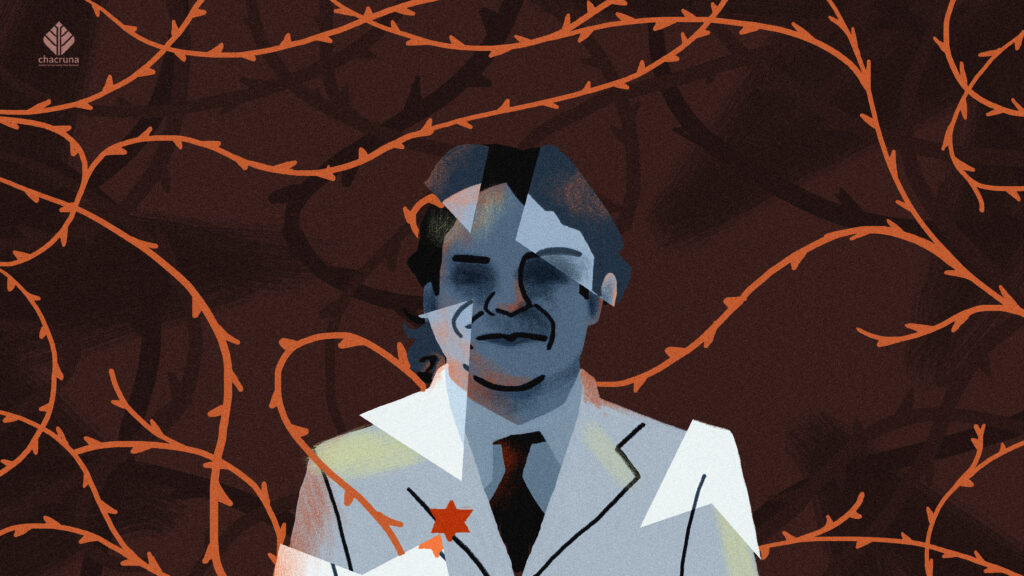
A Santo Daime padrinho’s trial and acquittal raise questions about systemic issues in the church.
After a monthslong trial that attracted high-level media attention and international coverage, Paulo Roberto Silva e Souza, the founder of Rio de Janeiro’s influential Céu do Mar Church, was acquitted by a judge in May.
During the trial, which began in January, Silva e Souza faced charges of sexual violation by fraud and psychological abuse. Accused by his former personal assistant, lawyer Jessica Nascimento, he was also suspended from church leadership by CEFLUSMME (Centro Eclético de Fluente Luz Universal Sebastião Mota de Melo), an organization within the broader Padrinho Sebastião Santo Daime line.
Controversy has continued to surround Silva e Souza, even after the acquittal. Classified by the Rio public prosecutor’s office, which is appealing the decision, as a “sexual predator,” his trial became a flashpoint within the Santo Daime community worldwide, raising questions about power, control, gender dynamics, and the need for reform in the church more broadly.
The Troubled History of Céu do Mar
Trained as a psychologist at Rio de Janeiro’s Universidade Gama Filho, Silva e Souza had his first experiences with Santo Daime in 1976, when he was working in the Amazon for the Brazilian government. He married Nonata, the daughter of influential Padrinho Sebastião Mota de Melo, founder of the Igreja do Culto Eclético da Fluente Luz Universal (ICEFLU) lineage and the Céu de Mapia village, after divorcing his first wife. The alliance provided Silva e Souza direct access to her family, considered one of the most powerful in the Santo Daime organization.
In 1982, Silva e Souza founded Céu do Mar in Rio de Janeiro, marking the first Santo Daime church outside of the Amazon. Its urban base helped its influence and reputation grow, raising public awareness of Santo Daime beyond Brazil, particularly in the United States.
As church leader, Silva e Souza rose to prominence in high-profile circles, bringing Santo Daime to a global audience through international travel and conference appearances. In 1998, for example, MAPS published a letter from member Maxi Cohen detailing an experience with Silva e Souza and asserting that he was “responsible for bringing ayahuasca through the Santo Daime to Rio, Europe, Japan, North America, and soon Africa.”
“Accusers allege that Silva e Souza perpetuated several incidents of harassment, manipulation, and sexual abuse of congregants, including employees, for years.”
Amidst Silva e Souza’s widening influence, allegations of abuses of power began to emerge. The earliest officially noted break was in 2002, when Canada’s Céu do Montreal – along with several other churches previously affiliated with Céu do Mar – ended their ties to the organization. An official investigation into Silva e Souza, conducted by the Centro Eclético de Fluente Luz Universal Rita Gregório de Melo – América Norte (CEFLURGEM-AN), the institution responsible for most of the Santo Daime churches in the U.S., began in December 2007. The group noted an “appearance of sexual misconduct in a ministerial relationship,” and stated they had received reports of inappropriate behavior that marked “a pattern of abuse.” Two years later, Silva e Souza was again conducting ceremonies in the U.S. after expressing regret and claiming his actions were due to the influence of spirits, which he said he healed through Daime. He also actively raised funds for his church and his family’s Guananshe Sanctuary spiritual resort at that time.
Amidst these scandals, Silva e Souza continued to make in-roads in the global spiritual community. In 2023, he was a featured speaker at Tibet House’s The Art of Dying and Living (the same year Nascimento began speaking to lawyers). In 2024, he participated in the Institute of Noetic Sciences’ conference. The program described him as a “renowned figure in the field of psycho-spiritual work within Amazonian communities.”
A Culture of Silence
Accusers allege that Silva e Souza perpetuated several incidents of harassment, manipulation, and sexual abuse of congregants, including employees, for years. Nascimento’s accusations, brought jointly with Rio’s prosecutor’s office, were, as Dr. Jessica Rochester, founder and Madrinha, Céu do Montreal, noted, “no surprise” based on the “long history of abuse on the part of…Silva e Souza.”
Nascimento joined Céu do Mar in 2015. She began working as the padrinho’s personal assistant in 2020, and in 2021 became the executive director of his NGO. She alleges that the abuse began in April 2022, a date also reported in O Globo. In December of that year, she left the church after being expelled by Madrinha Nonata Melo e Souza, Silva e Souza’s wife, as part of what she says was a public shaming campaign. According to Nascimento, who spoke to Chacruna with the help of a translator, “she silences women and abuses them religiously” and harassed her through repeated calls and texts when she suspected she was sexually involved with her husband.
“She used to say that I had destroyed her family and threatened to show my picture with all of Mapiá, which is a nucleus of power for the Santo Daime religion and where the royal family lives, so I would never be welcome there,” says Nascimento. The expulsion from Céu do Mar isolated Nascimento personally and professionally, she shares.
No formal charges have been filed against Melo e Souza.
The story is familiar to Isabela Augusto de Lima, another alleged victim of Silva e Souza who provided witness testimony in Nascimento’s trial. Augusto de Lima shared with Chacruna that she began working with Silva e Souza in 1984, purchasing the land where the church was built in 1986. She says that she was abused by Silva e Souza and often witnessed his mistreatment of other followers. She eventually left the church in 1992, but did not speak about the alleged abuse until Jessica’s trial.
“There was a culture in his church of accusing all of the women of going after and chasing him, but I could see what was happening. He was always going after these women, and I witnessed that,” she says, speaking with help from a translator.
Now, decades later and in the wake of the global #MeToo movement, Augusto de Lima regrets not speaking up sooner about her own alleged abuse. She views the current moment as a second chance. “I saw all of these situations happen, but the only resource I had back then was just to leave,” she says. “It was very hard, because I’d dedicated my life and money to the church.”
“There was a culture in his church of accusing all of the women of going after and chasing him, but I could see what was happening. He was always going after these women, and I witnessed that.”
Isabela Augusto de Lima
Both Augusto de Lima and Nascimento allege that they were given drugs by Silva e Souza, who presented himself as a teacher who would show them how to navigate altered states. Nascimento says that he gave her “LSD, MDMA, and a very potent strain of cannabis with a high level of THC.” A few decades earlier, Augusto de Lima alleges that Silva e Souza gave her ecstasy and cocaine. The women shared that he would abuse them during these sessions, framing the sexual act as an important final step in their healing.
Nascimento’s Case Builds
Despite her expulsion from the church, Nascimento continued working for Silva e Souza until 2023, the year she decided to sue Silva e Souza. “I knew I wasn’t the only one who had been through this with him,” says Nascimento. “Suing him was part of a strategy to help other women who had suffered these abuses feel strong enough to come out and speak about what happened.”
In October 2024, in response to the lawsuit and growing accusations against Silva e Souza, CEFLURGEM-AN “suspended indefinitely all invitations and permission for Paulo Roberto [Silva e Souza] to tour and/or lead works within CEFLURGEM-AN churches.” On November 1 of that year, ICEFLU (the Eclectic Church of the Fluent Universal Light / Igreja Eclética da Fluente Luz Universal in Portuguese), the main organizing body of Santo Daime, published a statement on the investigation and case. In it, the authors, “in view of the lawsuit with allegations of sexual and labor abuse against” Silva e Souza, “[consider] his possible conduct of abuse and sexual harassment to be unacceptable from an ethical point of view.”
In December 2025, O Globo published an open letter to the Daime Council of Elders written by United States citizen Maria del Castilho. In it, she alleges abuses that took place in 2007, when she participated in several ceremonies at Céu do Mar, during which time she says Silva e Souza sexually assaulted her while offering “healing work.”
“My goal is to ensure this does not happen to anyone else and to express the harm and devastation that Padrinho Paulo’s actions have caused in my life and on my spiritual path in Daime,” writes del Castilho. “As a form of redress, I would like this matter brought to the attention of the Council of Elders and treated with seriousness. I ask that women—especially newcomers—be protected. I ask that no padrinho be permitted to touch a woman under the pretext of ‘healing’ her without another woman present.” That same month, Rio’s Public Prosecutor’s Office requested the padrinho’s preventive detention, a request which was denied by the judge. Chacruna could not obtain further information about the reason for the denial.
According to Jessica and another contact who wishes to remain anonymous, the trial proceedings are under judicial secrecy and are not currently available to the public.
The trial officially began in January 2026, presided over by Judge Renata Travassos Medina de Macedo. Silva e Souza’s formal charges included “allegations of sexual violation by means of fraud and psychological violence, committed through the abusive use of spiritual authority to vitiate the victim’s consent,” reports O Globo.
Several other female victims who provided witness testimony for the trial were encouraged by the prosecution to file their own individual suits against Silva e Souza. As of publication date, no additional lawsuits have been filed.
On March 5, 2026 the Public Prosecutor’s Office of Rio de Janeiro officially requested Silva e Souza’s conviction, concluding that the “materiality and authorship of the crimes” were proven during the January hearing. Prosecutor Flávia Abido Alves stated that the request to convict for sexual assault by fraud was “further aggravated because the member of the Santo Daime religion was the complainant’s boss and because, in addition to the employment relationship, he had a relationship of authority and power over her, as she frequented the church that [Silva e Souza] presided over.” Silva e Souza’s defense consistently denied all accusations.
The Decision to Acquit
In May of 2026, Judge Medina de Macedo acquitted Silva e Souza, ruling that evidence, including messages and Nascimento’s diaries, indicated a “voluntary and reciprocal romantic relationship” and that there was no evidence of coercion or fraud.
“There is no evidence of manipulation by the defendant under the pretext that the relationship was linked to a healing process—an essential element for establishing the criminal offense,” wrote the judge (as reported in O Globo). Rather, she continued, Nascimento’s diary entries expressed “profound disillusionment” only after she was exposed to the rest of the congregation, and the relationship only ended when Nascimento was asked to return funds on a job that was not completed.
The judge ruled that witness testimony from other alleged victims was “legally irrelevant” because it did not pertain to Nascimento’s specific case. A charge of psychological violence was dismissed because of a lack of “expert analysis and evidence proving that the defendant had acted deliberately to cause harm.”
Nascimento was “devastated by the acquittal,” she says, but heartened by the treatment she received from the Chief of Police and Rio’s Ministry, including the public prosecutor, who are appealing the decision and have publicly classified Silva e Souza as a “sexual predator.”
Nascimento criticizes the judge for what she describes as a lack of consideration for herself or Silva e Souza’s other alleged victims. “She didn’t consider the difference of power between us or that he was my boss and my religious leader. She didn’t take the word of any victims into account.”
Nascimento also states that her diary was stolen by another witness who testified on Silva e Souza’s behalf, whom she alleges was treated “more favorably” than his other supposed victims.
“Even though I was destroyed and devastated by the acquittal, I feel comforted because everyone knows that justice was not done,” she says. “I want people to know that this is not my problem, or the problem of his victims—rather, it is a shame for the Brazilian legal system.”
“Silva e Souza’s role as a psychologist also supported Santo Daime’s missionary mission, helping legitimize it through the secular language of science and mental health. His alignment with Padrinho Sebastião and his family gave him a privileged, protected position that critics say he used to his benefit.”
Silva e Souza’s supporters argue that his accusers took advantage of a venerated elder, and that Nascimento lashed back with a lawsuit after community members started speaking badly about her. A Reddit post, which was removed by its original authors and then reposted by another account, shares an email sent to international recipients by two Indigenous Yawanawá women whose names were redacted upon reposting. The letter argues that people have heard only one side of the story, and implies that Silva e Souza’s accusers are misusing the increasing agency women possess to make accusations of sexual abuse since the #MeToo movement.
Discover the Indigenous Reciprocity Initiative of the Americas
Santo Daime’s Systemic Issues
Regardless of the official ruling, corroborated accounts of alleged abuse by multiple women, together with the public impact of the trial have sparked conversations—and further controversies—across every level of the organization. Nascimento states that Silva e Souza’s allies in the United States celebrated his acquittal. She alleges they also provided significant financial support to him for his defense.
The questions raised by Silva e Souza’s trial is a symptom of systemic issues in society at large, of which Santo Daime is a microcosm, says Paulina Valamiel, a sociologist and daimista who is also Chacruna’s Research and Communications Officer. The patriarchal doctrine prepares women in the church for traditional roles often defined by symbolic, rather than real, power. Wives of religious leaders, Valamiel explains, are expected to be loyal partners in the physical and spiritual realms, especially amidst destabilization caused by scandals.
Silva e Souza’s role as a psychologist also supported Santo Daime’s missionary mission, helping legitimize it through the secular language of science and mental health. His alignment with Padrinho Sebastião and his family gave him a privileged, protected position that critics say he used to his benefit. Legal documents from Céu do Mar reportedly list Silva e Souza as the eternal spiritual guide of the church, regardless of changes to the directors and board of the organization.
Both Nascimento and Augusto de Lima agree that a reckoning is overdue. In spite of the acquittal, “this is an opportunity for the religion and doctrine to look at itself and do something, because these kinds of situations have been happening since the beginning,” says Nascimento. She hopes structural changes will come with changes in leadership.
The women are hopeful that the case will draw international attention, and that Silva e Souza will eventually be held fully accountable for what they claim are decades of alleged abuse and misconduct. Both women also hope that relationships between the women of Santo Daime will become stronger, and will give others courage to come forward with their own allegations of abuse. “My hope is that my trajectory and story will inspire other people,” says Nascimento. “And, more than that, the legal system can change to be more sensitive to judge these kinds of cases. I am a lawyer and work now with victims of sexual assault, so to also understand this pain and has made me stronger and more able professionally to deal with cases like this.”
“This was already a marginalized religion, so the impact is very negative,” says Augusto de Lima, “but this is a cleansing that should have happened many years ago. This is necessary for the evolution of our religion. Just as we all go to the Daime to drink ayahuasca to heal ourselves, now the Daime is going through its own process of healing.”
Silva e Souza did not respond to interview requests for this article.
Disclaimer: This article reports allegations made by interviewees concerning Paulo Roberto Silva e Souza, founder of Céu do Mar Church, Rio de Janeiro, Brazil. Paulo Roberto Silva e Souza was acquitted of sexual violation by means of fraud and psychological violence following a criminal trial in Rio de Janeiro, Brazil, in 2026. The acquittal means that he was found not guilty and was not convicted; it does not itself determine the truth or falsity of every allegation described in this article. The allegations are presented as accounts given by interviewees, not as established findings that he committed the alleged conduct. Paulo Roberto Silva e Souza denies wrongdoing and was invited to respond.
Ayahuasca and Sexual Abuse Resources
- CHACRUNA INSTITUTE. Ayahuasca Community Guide for the Awareness of Sexual Abuse. Chacruna Institute, 2020. https://chacruna.net/ayahuasca-community-guide-for-the-awareness-of-sexual-abuse/.
- CHACRUNA INSTITUTE. Guia da Comunidade Ayahuasqueira para Conscientização sobre Abuso Sexual Instituto Chacruna. Chacruna Institute, [S. l.], p. 1-6, 2020. Disponível em: https://chacruna.net/ayahuasca-community-guide-for-the-awareness-of-sexual-abuse/.
- FERNANDÉZ, A. C. Power and legitimacy in the reconfiguration of the yagecero eld in Colombia. In B. C. Labate & C. Cavnar (Eds.), The expanding world ayahuasca diaspora (pp. 199–216). New York, NY: Routledge, 2018.
- KRUGER, D. J., ADAY, J. S., FIELDS, C. W., KOLBMAN, N., GLYNOS, N., BARRON, J., … & BOEHNKE, K. F. Psychedelic therapist sexual misconduct and other adverse experiences among a sample of naturalistic psychedelic users. Psychedelic Medicine, 3(1), 41-47, 2025.
- MESQUITA, Carolina Pereira Lins. Me too e a quebra de silêncio. Contemporânea, [s. l.], v. 10, n. 2, 2020.
- PELUSO, Daniela. Ayahuasca attractions and distractions: Examining sexual seduction in Shaman-Participant Interactions. In: LABATE, Beatriz Caiuby; CAVNAR, Clancy. Ayahuasca and Shamanism in the Amazon and Beyond. [S. l.: s. n.], 2014. cap. 10, p. 231-251.
- PELUSO, Daniela; SINCLAIR, Emily; LABATE, Beatriz; CAVNAR, Clancy. Reflections on crafting an ayahuasca community guide for the awareness of sexual abuse. Journal of Psychedelic Studies, [s. l.], v. 4, n. 1, p. 24-33, 2020.
- PELUSO, Daniela. Chacruna Survey Results on the Awareness of Sexual Abuse in Ayahuasca Settings. Chacruna Institute, [S. l.], p. 1-4, 28 jan. 2023. Disponível em: https://chacruna.net/chacruna-survey-results-on-the-awareness-of-sexual-abuse-in-ayahuasca-settings/.
- SINCLAIR, E. J. (2024). Dismantling the Myth of “Mother Ayahuasca”: Gender Dynamics and Cosmology within Mestizo Ayahuasca Shamanism, Iquitos, Peru (Doctoral dissertation, Durham University). Disponível em: http://neip.info/novo/wp-content/uploads/2026/04/Sinclair_Sexual_Abuse_Ayahuasca_Durham_2024.pdf.
Art by Karina Alvarez.

Help us celebrate our 10th anniversary! Buy our anniversary t-shirt today!