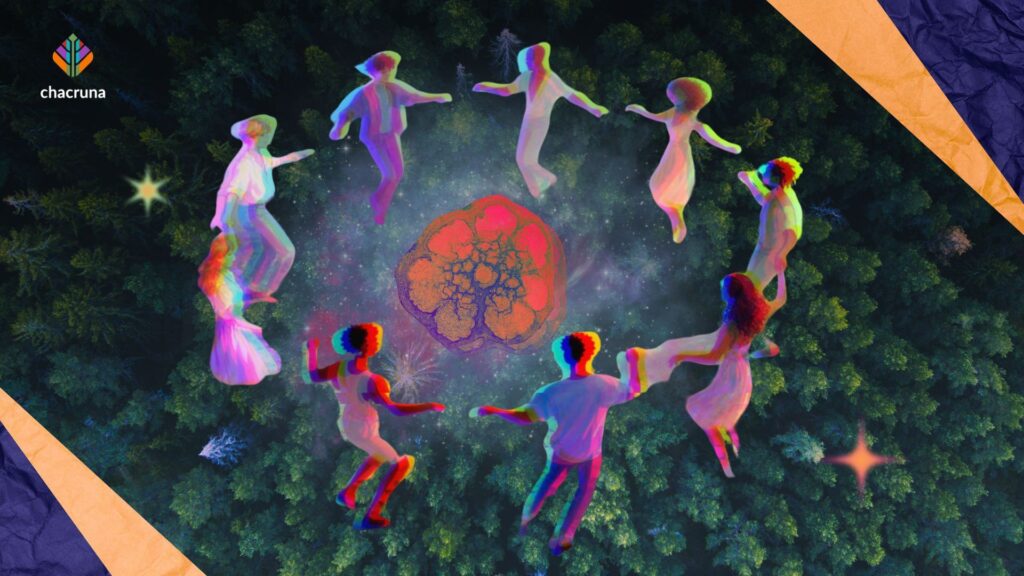
There is a samaúma tree in the village of Morada Nova, on the Envira River, where the cathedral of the forest forms naturally between its colossal roots. There, under the canopy of this tree that filters the light of the full moon, about a hundred people consecrate the huni (ayahuasca) on a starry night in September 2019. People from different tribes: Shanenawa, Huni Kuin, Puyanawa, among many other relatives from other villages and Indigenous lands in Acre. And some nawa (non-Indigenous people) who, like me, had traveled from afar to be there. Everyone dancing or meditating intently, no one fighting, no one crying. Carlos Brandão Shanenawa, chief of Morada Nova, observes and says: “We are doing what nature asks of us, and I am very happy.” It is not a party. It is a celebration with shamanism. It is the return of a spirit that was almost lost in the time of forced labor in the rubber plantations, when the rubber barons banned everything that belonged to the Indigenous peoples, when evangelical missions demonized the ayahuasca vine, when being an Indigenous person was shameful.
“We are doing what nature asks of us, and I am very happy.”
Carlos Brandão Shanenawa, Chief of Morada Nova
This scene I witnessed in 2019 is the result of a transformation that began decades earlier. Since the 1990s, some Huni Kuin leaders had been reviving their spirituality and expanding their culture. The movement gained momentum in the 2000s, when figures such as Fabiano Huni Kuin, Benke Ashaninka, Biraci Yawanawa, Erison Nukini, Haru Kuntanawa, Tuin Nova Era, and Nainawa Pai da Mata began to travel around Brazil and the world, building a network of allies in a process of cultural revitalization that would cross ethnicities, rivers, and international borders. Fabiano Huni Kuin was a pioneer in bringing the rituals to Rio de Janeiro, creating the Guardiões da Floresta (Guardians of the Forest) movement and doing what would previously have been unthinkable: performing Indigenous ayahuasca ceremonies in cities. Then came the big festivals—the Yawa Festival with the Yawanawa in Rio Gregório, the Eskawatã Kayawai Festival with the Huni Kuin in Rio Humaitá—bringing together diverse Indigenous ethnic groups and non-Indigenous guests from all corners of Brazil and the world in a celebration that was both a political affirmation and a spiritual reconnection.
Zezinho Yube Huni Kuin, filmmaker and former secretary of Indigenous Peoples for the government of Acre, witnessed this cultural revolution village by village in Acre. At first he questioned: “Are we selling our knowledge to white people?” But when he experienced it, he understood the new process underway. That was when he realized the strategic benefit: while evangelical churches continued to convert, while forró music and white people’s dances entered the villages, these leaders responded not with isolation, but with affirmation: they held traditional parties, strengthened rituals, and invited the nawa not as consumers, but as allies. Ayahuasca was not being sold. It was being used as it always had been by the ancient shamans: to make alliances. Only now the alliances were not just with the spirits of the forest, with the owners of the animals, with the forces of the different dimensions of the cosmos. They were also with people from other parts of the world, new partners capable of helping to protect the territory, strengthen the culture, and perhaps guarantee the economic and political autonomy of the villages in Acre.
Carlos Shanenawa remembers exactly when he decided to change everything. There was a festival in his village in 2016 that had trouble, drinking, people on the flor, women crying. “It’s the last white man’s party, now it will only be traditional parties,” he told Zezinho. And that’s what he did. At the next festival, there were seven days of celebration with ayahuasca, singing, dancing, and painting. When it was over, the contrast was evident: everyone was hugging, feeling peaceful, connected with nature. Unlike the old festivals that always ended in fights. Carlos saw Chief Assis do Pinuya speak into the microphone at a festival in Caucho: “Before, we used to bring two or three cases of cachaça, and now we brought four liters of nixi pae to share with our brothers.” The reversal was complete: the medicine of the forest expelling the poison of the city.
For the Puyanawa, the return of the shaman began when Luis Puyanawa returned from a festival in the Huni Kuin Indigenous Territory on the Breu River. There he drank caiçuma (Indigenous fermented manioc drink), used rapé (snuff), drank ayahuasca (nixi pae), and returned with a fixed idea: “When I get back to my land, I will tell my relatives to start valuing our culture more.”
I have followed this story since the beginning. I arrived in Acre in 2003 to work in Cruzeiro do Sul. In my second week, I drank ayahuasca for the first time at the UDV center. Later that year, I visited my first Indigenous Territory—the Puyanawa Indigenous Territory in Mâncio Lima, at the invitation of Luís Puwe Puyanawa. I met Puwe along with Osmildo and Haru Kuntanawa, Erisson (Xinti), and Luís Nukini at OPIRJ (Organization of Indigenous Peoples of the Juruá Valley). That was where we would meet to talk and pass around some rapé.
When I visited the Puyanawa in 2003, the ayahuasca work was just beginning. The group was small – perhaps 20 or 30 people. Samuel Puyanawa, a teacher at the school in the Indigenous Territory, was not yet working with Puwe on this endeavor. “Samuel, let’s revitalize our culture,” Luís said. He joined in, and over time, the group grew. In 2011, the Puyanawa expansion of ayahuasca use required the chief to reposition himself in relation to the work. But there was a problem: the chief had become an evangelical Christian along with his entire family. This created tension that was only resolved when he renounced his white religion and reconverted to the Puyanawa cosmology through ayahuasca—at which point Joel Puyanawa ceased to be an evangelical pastor and became an ayahuasca chief.
Discover the Indigenous Reciprocity Initiative of the Americas
The influence of Benke Ashaninka and Biraci Yawanawa was decisive in this matter. It was in their presence that Joel’s father, who was still a chief, publicly gave his consent for ayahuasca to be considered a legitimate practice that was part of Puyanawa culture. The time had come to rescue ancestral knowledge and strengthen Indigenous culture, following what was also happening successfully with other peoples.
I recalled this whole story with Samuel on an unforgettable Sunday afternoon, on the beautiful white sand terrace where collective ayahuasca ceremonies take place today. It was the last day of the 2018 Indigenous Ayahuasca Conference. He also recalled that in 2005, his father, who was a teacher, passed the responsibility on to him. He thought: What now? “How am I going to teach without knowing?” Ayahuasca, he says, became his teacher. He asked for strength, with faith, and the medicine showed him: “It was through ayahuasca. It showed us what our ancestors lived through, the suffering they endured, and how far we have come. The vine transforms the mind and heart. It transforms the heart into a heart of light, a heart that speaks true words, sweet words. People ask: how can you speak like that? It is the transformation that the drink brings.”
This transformation that Samuel describes has deep and painful historical roots. Most of the Puyanawa people had lost everything—rapé, caiçuma, sananga, handicrafts. When the elders were captured by Colonel Mâncio Lima’s henchmen, any cultural practice was prevented. Samuel and his generation were born without this knowledge, without this spirit. Ayahuasca, he says, brought everything back: “We are Indigenous, we have our characteristics, but if we don’t speak the language, sing our songs, tell our stories, we don’t have the spirit. It stayed behind. When you surrender and start drinking ayahuasca, spirituality starts moving inside you again, becoming part of you. Then we change completely.”
“The change was not only spiritual. It was also material—and this concrete dimension separates this movement from any New Age romanticism. It is a political strategy for autonomy.“
The change was not only spiritual. It was also material—and this concrete dimension separates this movement from any New Age romanticism. It is a political strategy for autonomy. The Puyanawa planted more than 30,000 trees. The village had its traditional architecture revitalized. They created an agricultural cooperative to produce tons of flour per year without deforestation. The houses changed: canaraí thatched roofs, handmade furniture made from vines. Even the view of white people from the city changed. Businessmen, bank managers, federal police officers began to attend the rituals, seeing that the Indigenous people have knowledge, organization, and wisdom.
As we have seen, the path was arduous and the beginning was not easy. The old leaders criticized harshly: “They are not shamans, they have never been on a diet, they are deceiving the white people, it is too new.” Zezinho thought the same. The turning point came when he witnessed and experienced the rituals and understood something fundamental: “You don’t have to be a shaman to heal. The music itself, the songs, the medicines are the cure! Ayahuasca, rapé, sananga, kambô, these things heal. It is not people who heal, it is the medicines of the forest.” Something bigger than he had imagined was happening. Something that the old shamans might not have foreseen: shamanism was becoming democratized, collectivized, multiplying. The shaman was returning not as an individual figure, but as a collective practice.
And what about international expansion? Here the strategy becomes even more evident. Many countries are turning to these medicines, believing that they are transformation, a cure for a sick world. People have disconnected from their origins, from nature, and the market seems to have taken control of people’s lives. Zezinho explains: “Those who have used ayahuasca in religious centers want to know more.” They want to know the forest, the roots, and the owners of the medicine. There are social and financial benefits: the Indigenous people who participate in rituals abroad receive resources that transform villages. New partners and allies are vital for strengthening culture and achieving environmental sustainability. Samuel confirms this experience: outsiders come because they see the work on the internet, spend a week here, feel the power of the forest, and leave healed with new energy. “I’ve never heard anyone say, ‘Look, Puyanawa, I’m never coming back.’ Everyone wants to return.”
Chief Carlos sums up the historic reversal that is underway: “Ayahuasca is restoring values. We value language, medicine, the forest, shamans. We were forced to speak Portuguese and imitate the religion of the white man in order not to die. Now we no longer need that. Now white people come to the village to learn from the Indigenous people.”
This reversal has its rules. Carlos says that when he goes to take huni without his headdress, he gets punished: the spirit of the vine demands, asks, “Where is the headdress?” and teaches him the right way. The presence of evangelical churches, which was intense in previous decades, has decreased significantly in the last five years. Joel Puyanawa, who was evangelical, left the church and took up ayahuasca. Zezinho is not against any religion—he believes in God, in Jesus, as well as in the boa constrictor, in Dua Busê, and in Indigenous spirituality. But the path to regaining autonomy is clear: Indigenous roots prove to be more solid than any foreign conversion.
The festivals have become a privileged space for this transformation. Many different peoples meet, learn from each other, and create alliances that strengthen everyone. Learning circulates, transforms, adapts. Each people brings their music, their paintings, their ways of doing things. And everyone drinks together, sings together, dances together. When the sun begins to shine on the bright green leaves, the singing calms down and people return renewed from their visions. It is in this moment of collective enlightenment that understanding emerges. Zezinho observes everything and concludes: “We are experiencing a cultural revolution in Acre.” It is not nostalgia. It is active cosmopolitics—the expansion of politics to include plants, spirits, territories, and non-Western knowledge as legitimate protagonists in debates about the global future of humanity. When shamans speak with the voice of the forest spirits, they recover the history that has been silenced and affirm their culture and knowledge with all the strength and freedom that has always belonged to them.
“Ayahuasca emerges as a technology of sovereignty.”
Ayahuasca emerges as a technology of sovereignty. The Indigenous peoples of the Amazon demonstrate that it is possible to participate in globalized circuits without subordination, projecting themselves internationally while maintaining their territorial and cosmological roots. The more globalized it becomes, the more Indigenous it becomes. Under the samaúma tree, amid songs that rise with the tobacco smoke, the vine continues its ancient work: weaving alliances so that life may continue, so that the forest may remain, so that Indigenous peoples may exist not as relics of the past, but as proactive subjects of the future. The shaman has returned. But he has returned collectively, multiplied, updated. It is no longer just one person who travels between worlds—it is the entire people who move, who negotiate, who heal, who teach.
Art by Fernanda Cervantes.
References
Lessin, L. (2023). O retorno do pajé: o uso indígena contemporâneo da ayahuasca no Acre. In: ARAÚJO, Wladimyr Sena (ed.). História e representações em contextos de religiões e religiosidades. São Paulo: Editora Dialética, pp. 79-111.