Detailed survey indicates that active requests that imply undue appropriation of the forest medicine are rare
The issue of intellectual property is one of the main, if not the main, points of contention between Indigenous peoples and the academic or business research sector on plants, fungi, animals, and substances with psychedelic effects and therapeutic potential. This article aims to bring clarity to this field of dispute, starting from the premise that inaccurate or exaggerated information gives rise to the spread of alarmism without factual basis and hinders, if not impedes, negotiation between Indigenous communities and researchers so that traditional knowledge associated with it is recognized, respected, and remunerated, as stipulated by international treaties (Convention on Biological Diversity and Nagoya Protocol) and national legislations that enshrine the same principles, including that of prior consultation and consent with the holders of this traditional knowledge.
The issue of intellectual property is one of the main, if not the main, points of contention between Indigenous peoples and the academic or business research sector on plants, fungi, animals, and substances with psychedelic effects and therapeutic potential.
There are several substances and organisms that could be involved in the discussion, such as psilocybin from “magic” mushrooms (Psilocybe), revealed to Western biomedicine by the Mazatec people of Mexico; mescaline from peyote cactus (Lophophora williamsii); sanpedro or wachuma cactus (Echinopsis pachanoi), used respectively by Indigenous peoples of Mexico and the Andes; and the compound 5-MeO-DMT present in snuffs used by Amazonian ethnic groups, such as the yãkoana of the Yanomami, or in the secretion of the toad Incilius alvarius. However, the present analysis will be limited to the case of ayahuasca (also known in other Indigenous languages by names such as rami, kamarãpi, huni, dispãnī hew, tsĩbu, yageé, gaapi, kahpi, hayakwaska and nixi pae).
Ayahuasca is possibly the best known and most widely used of the forest medicines outside of its center of origin, the Amazon rainforest, where the plant ingredients thrive (the most common being the shrub chacrona and the vine mariri, or jagube, respectively Psychotria viridis and Banisteriopsis caapi) that dozens, perhaps more than a hundred, peoples use in its preparation. The drink spread across the planet not through the hands of its creators, but through the globalization of ayahuasca churches, such as Santo Daime and União do Vegetal (UDV), and neo-shamanic tourism that has its epicenter in the Peruvian jungle.
The so-called ayahuasca effect involves the synergistic combination of the substances N,N-dimethyltryptamine (DMT) from chacrona leaves with the beta-carbolines harmine, harmaline, and tetrahydroharmine from the vine (inhibitors of the monoamine oxidase, MAO, an enzyme that hinders the arrival of DMT to the brain). There is no question that this experiential beverage is an invention of Amazonian peoples that likely dates back before the 18th century, thus representing a unique early example of discovery that involves the widespread, complex, and organized use of plant medicine that is absent the level of novelty needed to substantiate modern intellectual property claims (in reality, it would not need to be an Indigenous innovation; any finding of common current use of the association of plants and their substances, which are, moreover, natural products, would in principle prevent the possibility of patenting).
Ayahuasca is also at the heart of an international movement seeking to reclaim Indigenous prominence amidst the growing popularity of this medicine for its therapeutic benefits, for example in retreats, centers, and clinics in South and Central America that treat people with mental disorders living in wealthy countries, such as war veterans with depression, anxiety, and post-traumatic stress. Five Indigenous Ayahuasca Conferences have already taken place, the most recent from January 25 to 30, 2025 in the Brazilian state of Acre, where 207 members from 34 peoples of Brazil, Colombia, Peru, Mexico, Guatemala, Indonesia, Egypt and the USA decided to create a Council of Spiritual Leaders, to be formalized in 2027 in Colombia, and to jointly organize with the International Center for Ethnobotanical Education, Research and Service (ICEERS) the World Ayahuasca Forum in Girona (Spain), between September 11 and 13, 2026.
At the fifth conference, the letter adopted by the plenary, in which the 78 “nawa” (non-Indigenous) did not vote, demands “that organizations be monitored, prohibited and held accountable for attempts to create patents without proper consultation and consent, as well as for the production, sale and misuse of traditional medicines that are the ancestral knowledge of Indigenous Peoples.” Further on: “We oppose the creation of patents as well as any attempt to exploit the genetic heritage culturally associated with traditional indigenous medicines, as well as any form of appropriation of the heritage of Indigenous peoples.” The manifesto also defends the integrity of this heritage and its collective intellectual property rights and calls for the mandatory implementation of international agreements that protect Indigenous peoples, their territories, cultures, genetic heritage, and intellectual property. Finally: “We demand that health, judicial and criminal institutions as well as research institutions work ethically, respecting the values, knowledge, intellectual property and rights of Indigenous Peoples to free, prior and informed consultation prior to the expression of consent.”
To support the discussion that led to the drafting of the letter from the fifth conference, a preliminary survey of patents related to the ceremonial beverage was presented at the plenary meeting. This survey was conducted using keywords such as ayahuasca, Banisteriopsis caapi, Psychotria viridis, DMT, and harmala alkaloids from the vine, such as harmine and harmaline, according to a report published in Portuguese by one of the authors of this article (ML) in the Brazilian newspaper Folha de S.Paulo. According to the presentation, up to May 2024 there were a total of 543 registered patents, a high number that made a strong impression on the meeting participants. Among these participants, a claim circulated that these patent holders were earning millions of dollars from intellectual property rights related to ayahuasca. At that time, no breakdown of the various possible situations related to patent applications was presented, such as whether they had been accepted, rejected, or expired, or whether there might be double or multiple counting of the same invention, forming a family of patents presented in different patent offices.
In order to shed more light on this raw data, one of the authors of this article (PEC), at the request of the other author (ML), conducted a detailed search of related patents focusing on the claims, using a search equation that selected only documents in which the terms ayahuasca, its constituent plants (B. caapi, P. viridis), its active principles (DMT, harmine, beta-carbolines), or other tryptamines and MAO inhibitors appeared explicitly, in combination with terms indicating psychedelic use or therapeutic application to treat depression, anxiety, post-traumatic stress and problematic drug use, among other disorders. This limitation to what is included in the claims is justified because it is in this field that the scope of the requested protection is legally defined, that is, where the patent applicant seeks to appropriate a concrete technical object. In this way, merely descriptive or contextual mentions present only in the descriptive memorandum of the request are excluded, and the analysis focuses on effective attempts at exclusive protection over the substances of ayahuasca, their combination, or formulations aimed at reproducing the pharmacological effect.
The use of these filters resulted in 279 documents, halving the number of possible violations of Indigenous rights regarding traditional knowledge associated with ayahuasca. The next step was to eliminate 13 erroneous records due to the coincidence of ambiguous words, acronyms, or technical terms unrelated to alkaloids, psychopharmacology, ethnobotany, or traditional plants, e.g. requests in the areas of engineering, mechanics, electronics, construction, telecommunications, materials, etc., for example, citing the acronym DMT unrelated to dimethyltryptamine, and to classify the requests into six categories according to the object and nature of the protection sought, presented here in descending order of threat to Indigenous knowledge:
Ethnobotany/Direct use of plants (seven cases, 2.5%) – Explicit claim of B. caapi, P. viridis, chacrona, vines, or other plant species traditionally associated with the ayahuasca beverage. Includes standardized plant extracts, fractions, extraction processes, or preparations functionally dependent on these plants. May include reconstruction of the traditional method of preparation.
Biochemical mimicry/Ayahuasca effect (55 occurrences, 19.7%) – Claims involve a functional combination of DMT or analogous compounds with beta-carbolines. That is, protection requests for formulations containing tryptamines and MAO enzyme inhibitors that emulate the so-called “ayahuasca effect.” Use of terms such as “synthetic ayahuasca,” “pharmahuasca,” “ayahuasca type.” The invention focuses on doses, proportions, formulations, routes of administration, or controlled release to replicate the pharmacological effect of the traditional beverage. Traditional plant material is not directly claimed.
Isolated chemistry/Structural derivative (two entries, 0.7%) – Claims of isolated compounds (DMT, harmine, harmaline, etc.) or synthetic derivatives (analogs, prodrugs), without functional combination of DMT with MAO inhibitors and without the use of traditional plants. For example, a modification of the DMT molecule, or beta-carboline, or its precursors and metabolites, but separately, not in conjunction. It may include a new therapeutic indication for the proposed drug.
Contextual or secondary reference only (201 cases, 72%) – Ayahuasca and its plants appear only as background, mention of previous use (“prior art”), description or list of examples. In the claim, the reference appears as an option among many, without a specific functional role. There are no proportions, extractions, combination of inhibitors with DMT, nor technical dependence on the traditional preparation.
Trademark/Branding (no records) – Use of the word “ayahuasca” as a trademark, commercial name, supplement, cosmetic, accessory or advertising element, without a technical-functional claim about the substance or pharmacological combination.
General botany unrelated (one example, 0.4%) – Patent applications on plants, phytochemistry or plant extracts without structural, functional, or ethnobotanical relation to ayahuasca. There is no DMT combined with inhibitors, nor any functional reference to the ayahuasca effect.
Considering that the purpose here is to increase clarity on the dispute between Indigenous peoples and academic researchers and entrepreneurs regarding the appropriation of traditional knowledge, it seems evident that the first two categories (direct use of plants and mimicry/ayahuasca effect) are the most serious and relevant to the debate; one could also, to be conservative, include the third class (isolated chemistry), but with little quantitative effect, as this would increase the total number of concerning cases from 62 to 64 problematic occurrences, or a total 22.9% of the 279 documents identified. Still a worrying number, but it should be noted that it is an order of magnitude smaller than that appearing in the data on more than 500 patents related to ayahuasca. This methodological approach, focused on claims, significantly reduces the noise of broad searches in intellectual property directories and avoids the inflation of results that occurs when considering all textual occurrences in the patent application, including the abstract or description.
This methodological approach, focused on claims, significantly reduces the noise of broad searches in intellectual property directories and avoids the inflation of results that occurs when considering all textual occurrences in the patent application, including the abstract or description.
It should be considered, however, that a patent application may or may not be granted and that it may be active (still in process) or dead, that is, expired, abandoned, or rejected. For the purposes of the legitimate political mobilization of Indigenous peoples against the appropriation of traditional knowledge, cases of extinguished, denied, abandoned, or expired patents are certainly still important, as they denote recurring attempts to dispossess original intellectual productions, but it also seems evident that they have secondary priority for the defense of rights at risk at the present time. It should be noted that only patents classified as “granted” and “active” generate exclusive rights in force, and that the other categories do not imply effective current protection.
Of the 279 documents analyzed, 116 (41.6%) were granted and 163 (58.4%) did not become patents. In terms of validity, 91 granted patents are active, while 25 have already expired. Among the ungranted patents, 124 remain pending and 39 are definitively closed. A patent classified as granted and in force refers to the fact that at least one registration belonging to the same family of applications filed in various jurisdictions is accepted and in force in some patent office in the world. That is, the status is evaluated at the level of the international family, and not necessarily of each individual registration in a given country. It may happen that, as the different applications are examined in other jurisdictions, some—or even all—may be rejected, abandoned, or expired, given that the international filing and processing procedures are dynamic and evolve over time. Therefore, the information presented here should be understood only as a snapshot of the moment. Here is a summary table:
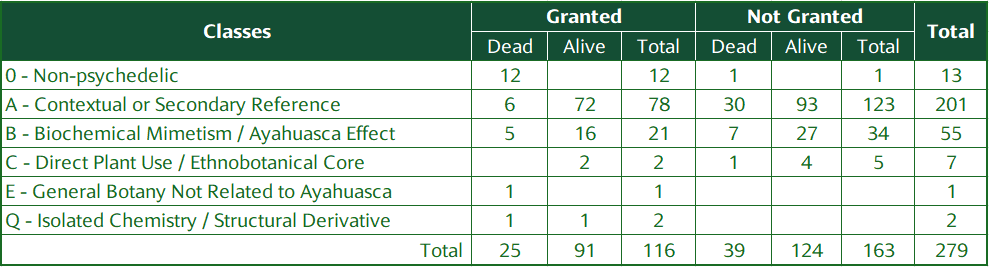
Biochemical mimicry accounts for 19.7% (55 cases), but only 16 patents of this class have been granted and remain in force. One of them is the now-defunct WO2022251351A4 patent, which claimed protection for salts and crystallized forms of DMT salts, as well as preparations, pharmaceutical compositions, and use in treating neurological diseases. The patent holder was Atai Life Sciences, now AtaiBeckley. Although it refers to one of the active compounds of ayahuasca, the protection covers synthetic chemical forms, characterizing biochemical mimicry and optimization of the drug without the use of plant extracts. The company is owned by Christian Angermayer, a German-born investor who has invested US$100 million of his family’s funds in a portfolio that includes other tryptamine psychedelics such as psilocybin and 5-MeO-DMT. Its business model presupposes intellectual property protection as a guarantee of recovering the costs of conducting phase 3 clinical trials to obtain approval for new drugs from regulatory bodies, such as the U.S. Food and Drug Administration (FDA).
Among the pending patents that have not yet been granted, but still may be granted, is WO2021/259962, which explicitly claims a kit and a composition combining DMT and harmine, the combination at the pharmacological core of ayahuasca. The application from Reconnect Labs, originally submitted by the University of Zurich, specifies the sublingual administration of harmine followed by DMT, configuring what the literature defines as “pharmahuasca,” which does not use plants directly but functionally mimics traditional knowledge. Reconnect, however, published a “patent pledge” stating its intention to “acknowledge and honour traditional, Indigenous medicinal practices and cultures, including the traditional uses of the natural plant medicines (such as ‘ayahuasca’) and the key role that these traditional medicinal cultures and practices play for the health and conservation of these Indigenous cultures, communities and their natural ecosystems.” The company also promises not to pursue patent WO2021/259962 against ayahuasca practitioners: “We, Pledgors, promise not to bring any suit for infringement of our Pledged Patents against any Indigenous communities or practitioners who use natural DMT-containing plant medicines (such as ayahuasca) for traditional ceremonial or medicinal practices (‘Pledge Recipients’).” Furthermore, in line with its ethical statement, the company allocated 20% of its ownership to the Reconnect Foundation, a non-profit organization with the mission of promoting benefit-sharing for ecosystem restoration, biocultural conservation, and support for Indigenous sovereignty and rights: “Reconnect Foundation is committed to actively engage in dialogue and consultation with Indigenous stakeholders and Indigenous-led organisations regarding benefit-sharing and to support the creation of Indigenous-led benefit-sharing processes and frameworks.”
Another striking application, which was never granted and is now listed as inactive in the patent records, is number DE102016014603A1, filed in Germany by an unidentified individual. It explicitly claims combinations termed “synthetic ayahuasca” with at least two active ingredients (harmine and DMT, for example), which mimic the effect of the plants without necessarily using the original plant material, encompassing the production of these active ingredients via synthesis or purified extraction to reproduce the pharmacological effect.
In the most serious situation, that of the seven applications for protection covering the direct use of plants, only two have been granted and are still active. Four others are still pending, without a final decision, and one is expired: patent number USPP5,751P obtained by Loren Miller in 1986 in the United States. It was an application for protection for a specific variety of B. caapi that was rejected in 1999, reinstated in 2001 through an appeal, and definitively expired in 2003, without any record of significant commercial gains for the holder.
Also receiving significant attention in 2022 was the news that the Canadian company Filament Health was developing an “ayahuasca pill” for launch in the psychedelic drug market. A related patent application appears in our research, but in a disguised manner: registration WO21253116 refers to the extraction of psychoactive compounds from organisms for use in medicine, which in principle covers the plant extract of ayahuasca plants, although only DMT is mentioned in the claims. The company planned to market the product as a “natural” alternative to synthetic drugs that might encounter resistance among consumers sensitive to the corporate medicalization of psychedelics that have been used for so long by traditional peoples. Furthermore, the combined extracts supposedly contained other alkaloids present in the plants, reinforcing the image of a natural product that takes advantage of the so-called “entourage effect” (the presence of dozens of potentially beneficial substances interacting with each other, and not just the few isolated components – DMT and/or beta-carbolines – sought for by pharmacological reductionism). The patent was granted and is in effect.
When questioned at the time about having consulted Indigenous peoples, founder and CEO Benjamin Lightburn stated that Filament had contacted ayahuasca communities in Peru, without specifying which ones. “Our research needs to progress before these relationships can be formalized and made public,” he stated at the time. “We recognize that there are many perspectives on the study of ayahuasca. The groups that we’ve communicated with believe in the healing power of the plants and that humanity stands to benefit from it.” Three years later, the company seems to have abandoned the ayahuasca pill, as since 2022 its website has no longer featured any news about the potential product, focusing instead on publicizing partnerships and clinical trials with its “botanical” psilocybin formulation PEX010, whose extraction is obviously covered by the extensive patent obtained for methods of extracting psychoactive compounds from organisms.
Another telling case is that of patent number US2018/0021326 filed in the US in 2017 by Paul Stamets, a visionary mycologist who attracts large audiences to lectures at psychedelic conferences. In this filing, he sought protection for the neurological therapeutic use of psilocybin and psilocin, the psychoactive principles of “magic” mushrooms, in combination with nicotinic acid, a formulation that became known as the Stamets stack. Among the 20 items specifying the claimed invention, items 11 and 17 mention B. caapi and P. viridis among dozens of plant extracts that could be combined with the stack for their anti-inflammatory or psychoactive properties, from oregano and green tea to iboga and cannabis. It is evident that, even though mentioned in the claims, ayahuasca plants appear here in a somewhat peripheral way, with the clear purpose of expanding the patent coverage as much as possible and imaginable. In any case, the current status of the application appears as “abandoned.” Stamets has other patents granted for his stack, which cover Psilocybe mushrooms and lion’s mane (Hericium erinaceus) combined with nicotinic acid, with no mention to ayahuasca plants, all indicating that the purpose is to protect his own invention from copying, and not to prevent others from using the products involved. The mycologist also often draws attention to the need to address traditional Indigenous knowledge ethically.
Discover the Indigenous Reciprocity Initiative of the Americas
Another example that fits well within the concerns of Indigenous peoples is the patent filed in 2023 in Australia and the following year worldwide under number WO 2024254645A1. The list of 51 claims concludes by requesting protection for “the use of a composition according to any of claims 1 to 30 for the manufacture of a medicine for the treatment, alleviation or prevention of a psychological disorder.” The text mentions ayahuasca, DMT, and the B. caapi vine several times, but not chacruna (P. viridis), also listing extraction from other plant sources such as species of the genus Acacia (traditionally used in Australia), Virola (trees from tropical Americas with resin containing DMT, 5-MeO-DMT, and bufotenin), and Mimosa (such as jurema-preta, M. tenuiflora, a shrub from the Brazilian Caatinga biome widely used in ceremonial practices by Indigenous peoples and in the Afro-Indigenous religion Catimbó/Jurema Sagrada). The Google Patents directory lists the application status as “pending”.
The request was submitted, among others, by researcher Daniel Perkins of the University of Melbourne, and by the Psychae Institute, a non-profit research center created to investigate new psychedelic therapies to treat mental disorders and other illnesses, whose directors also include Jerome Sarris and Simon Ruffel. On its website, the organization has a section dedicated to reciprocity with Indigenous peoples for their traditional knowledge, in which it commits to applying the principle through various strategies: treatments developed will be, as far as possible, inclusive and accessible to Indigenous communities; consultation and engagement with Amazonian communities in the territory; work in cooperation with organizations globally aligned with ethical principles; support for biodiversity; and seeking opportunities for Indigenous groups to participate in the supply and distribution chains of medicines. Among the concrete examples, the center mentions financial support for the Australian organization Indigenous Psychedelic-Assisted Therapies (IPAT).
Four other documents out of the 279 appear in the survey claiming the extraction or use of tryptamines such as psilocybin, 5-MeO-DMT, and bufotenin, psychedelic substances somewhat related to components of ayahuasca, but without specific mention of the plants used in the preparation of the Amazonian beverage. Although some of them could be questioned as intellectual appropriation of traditional knowledge from other Indigenous peoples, they do not fit among the most pressing concerns of the ayahuasca-using peoples present at the Fifth Indigenous Conference and could therefore even be excluded from the survey, which, however, sought to be as comprehensive as possible in its search. Finally, there is also the curious case of a patent filed in Canada for the rapid fermentation of alcoholic beverages flavored with plant products, including ayahuasca; although it constitutes an obvious example of the misappropriation of natural products of ritual use, it does not seem to deserve much attention, especially since it is now extinct.
This is not an attempt to draw a conclusive assessment of the seriousness of the phenomenon of cultural and intellectual appropriation of Indigenous knowledge associated with ayahuasca, based on the survey and examples cited. That is a judgment that traditional peoples must make based on their professed values, the interests they defend, the best available information, and the relevant intellectual property laws. It should be noted, however, that a more detailed analysis of patent applications related to the ceremonial beverage, the plants and psychoactive substances present in it, as well as the entourage effect of their ingenious combination, indicates that there are few patents to which a real and current threat to Indigenous knowledge could be attributed — numbering in the dozens, if that, and not several hundred. With this information, leaders and representative organizations of the affected peoples can either conduct new surveys, refining what has been presented here with premises and filters that seem more appropriate to their purposes, or focus their complaints and challenges to intellectual property on those cases with the greatest damage or potential for damage to traditional knowledge.
The political mobilization around cultural appropriation encompasses many aspects beyond patents, such as the usurpation of ritual practices and their clothing, adornments, symbols, objects, or chants, disrespecting their sacred character for the original peoples.
However, this will not be a trivial undertaking, given the complexity of the issue of intellectual property, the multiple jurisdictions and the diversity of Indigenous peoples involved, not to mention the ayahuasca churches and neo-shamanic centers that proliferate in the so-called psychedelic renaissance, considerably expanding the gray areas where ethical values and legal rights become blurred. It thus becomes difficult to reach consensus capable of regulating the issue in favor of Indigenous peoples, although initiatives from entities such as Reconnect and Psychae are pioneering this inhospitable terrain. Furthermore, the political mobilization around cultural appropriation encompasses many aspects beyond patents, such as the usurpation of ritual practices and their clothing, adornments, symbols, objects, or chants, disrespecting their sacred character for the original peoples.
Regarding the legal aspect of intellectual property, it must also be considered that it will not be easy to expand the claim for protection of traditional knowledge associated with ayahuasca to the point of covering any and all technical objects involving components such as DMT and harmine, which have existed in synthetic form since 1931 and 1927, respectively. The name “harmine” itself derives from the plant species Peganum harmala, or Syrian rue, which served as raw material (and not the Amazonian vine Banisteriopsis caapi) to isolate the alkaloid back in the 19th century. Beta-carbolines with MAO-inhibiting capacity, moreover, exist in several other plants. The same consideration can be made regarding DMT, present in dozens or maybe hundreds of plant species, such as jurema-preta (Mimosa tenuiflora), in addition to being present in the brains of animals, including humans. This multiplicity of sources weakens the notion that Indigenous peoples can claim exclusivity over these compounds in isolation, since it would be problematic to demonstrate that any and all innovation with them derives directly and necessarily from the appropriation of traditional knowledge. Quite another matter, however, is the combination of these substances in the so-called “ayahuasca effect,” about which there seems to be no doubt that it is a legacy, widely disregarded, of traditional Indigenous knowledge.
Art by Mariom Luna.