If plants could speak, who would they elect to spread their message to the world?
In 2020, the rise of social media plant medicine influencers came on the heels of leading cultural figures sharing their psychedelic experiences in popular media, including the New York Times bestselling book, How To Change Your Mind by Michael Pollan, as well as the Netflix documentaries, Have a Good Trip and Fantastic Fungi.
After decades of dormancy tied to the declaration of the “War On Drugs” (1971) and the scheduling of numerous psychedelic compounds under the Controlled Substances Act in 1970, researchers at high-profile institutions like University of New Mexico and Imperial College London renewed clinical investigation of various psychedelics such as DMT and psilocybin in the 1990s and early 2000s, gradually opening the door to a renewed public dialogue around psychedelic compounds and the plants and fungi that harbor them.
“Social media has democratized access to plant medicine information and education unlike anything in history.”
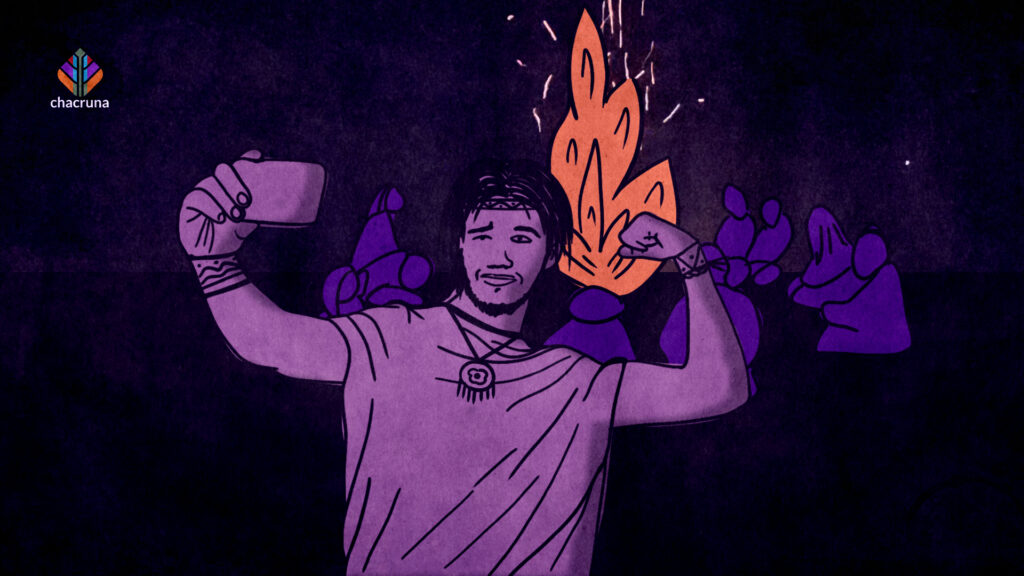
Coupled with the rise of psychedelic biotech companies like Atai and Compass Pathways and increasing media coverage of the emerging “Psychedelic Renaissance” circa 2020, the taboo around speaking publicly about psychedelics was lifted at the exact moment when influencers around the world were poised to take advantage of their large social media followings across various platforms. Suddenly anyone could jump online and instantly talk about their recent mushroom trip, create content at an ayahuasca retreat, or paraphrase news reports and psychedelic research for their audiences.
The routes to spread information – and misinformation – at an unprecedented scale and pace were already established, and the era of psychedelic influencers was born.
Social media has democratized access to plant medicine information and education unlike anything in history. Yet the same algorithms that accelerated public acceptance have also begun reshaping how these traditions and the science around psychoactive plants and molecules are communicated, decontextualized, and ultimately understood. As engagement becomes currency, ancient knowledge risks being stripped of vital context or reformatted into entertainment and consumer economy frameworks.
Platforms like Facebook, Instagram, TikTok, and even LinkedIn have become a fertile ground for people to share their direct experiences of the divine as experienced through entheogens like psilocybin mushrooms, ayahuasca, mescaline, iboga, and all manner of other ethnobotanical and synthetic substances. The mantle of “psychedelic thought leader” has become an attractive token for people to strive towards, while a thriving marketplace for the promotion and sale of these plants and substances – often outside of any regulatory system – has likewise emerged as a result of the creator economy applying its ever-expanding scope to the world of plant medicine. Retreats in the global south are known to partner with influencers to promote sales, while entheogenic churches offer rapid intake for new members to select from their menu of entheogens linked in the church Instagram bio. The rise of the “psychedelic influencer’” archetype took root internationally, with people flocking to places like Bali, Tulum, Iquitos, and Ibiza to build their own personal shamanic brands and launch paid courses and communities around the prospect of healing and unlocking abundance through sacred plant medicines adapted to their own proprietary protocols and personal brands.
“As engagement becomes currency, ancient knowledge risks being stripped of vital context or reformatted into entertainment and consumer economy frameworks.”
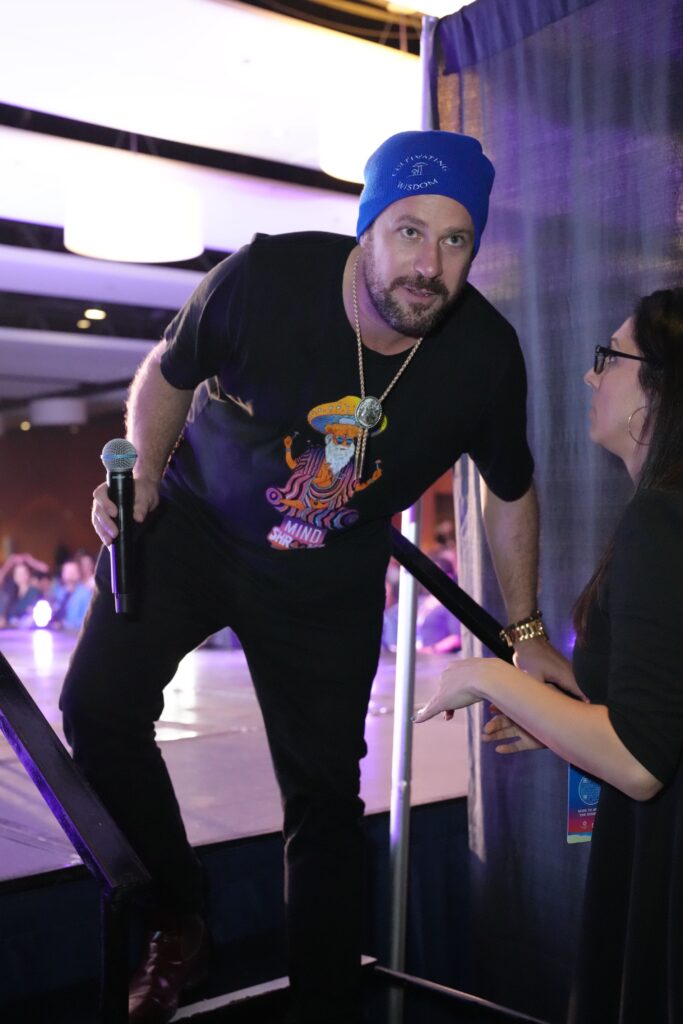
Over the last few years, an entire category of “plant medicine influencers” and content creators has emerged to populate social media timelines with educational content, personal experiences, archival material, and sales pitches touting the benefits of plant medicines. I should know; in 2023 I was surprised to be named “Psychedelic Influencer of The Year” at the Cannadelic Awards in Miami on stage alongside leading psychedelic figures like Rick Doblin and Paul Stamets who also received awards that night. Ironically, I’ve never considered myself to be an influencer, considering I have a degree in media and almost 20 years of professional experience in the digital media industry, but I wasn’t about to turn the award and comped hotel and flights down over semantics.
While the rise of the psychedelic social media influencer has democratized access to information and accelerated the adoption of plant medicine knowledge and practice by the international community for better or worse, it has also led to oversimplification, commodification, and performative behavior around what have long been held to be sacred traditions among Indigenous peoples.
The growing interest and associated market opportunity attached to the popularization of plant medicines globally has incentivized a rush to establish thought leadership and personal brand building in what is increasingly regarded as an emerging industry.
What is lost when the algorithm shapes the way plant medicine narratives are communicated? What happens when traditional living knowledge systems that are inseparable from their biocultural heritages are decontextualized and uploaded into 90 second highlight reels adapted to the attention economy and optimized for engagement?
“What is lost when the algorithm shapes the way plant medicine narratives are communicated?”
Recent high profile endorsements of psychedelics have even extended into the arena of livestreaming to a global audience while tripping. In the last year, centimillionaire Bryan Johnson has livestreamed a series of his high dose psilocybin mushroom journeys and 5-MeO-DMT sessions to an audience of millions around the world, drawing praise and criticism alike from people in the psychedelic field and beyond. While some defended his public self-experimentation as helping to destigmatize psychedelics and inform more extensive data collection thanks to the extensive biometric testing protocol he deployed, others see his antics as a self-promotional stunt that is likely to encourage imitators who don’t have the same level of personal resources and aftercare that Johnson does.
The ability for plant medicine content to reach a broader international audience has tremendous upside, but there are clearly pitfalls to the marriage of Indigenous wisdom and consumer-facing short-form content; generations of knowledge and experience get stripped of their sociocultural and environmental context, compressed into algorithmically friendly talking points, and repackaged as consumer-facing trends and wellness culture trivia.
At their core, social media platforms like Meta and TikTok are ad platforms. In an attention economy, strong viral hooks are rewarded. This incentivizes creators to do anything necessary to capture the fleeting attention of platform users, removing anything that doesn’t fit this narrow agenda as an extemporaneous non sequitur. A rigidly researched and exhaustively compiled academic tome on the ethics of plant medicine intersectionality with capitalism and colonial dynamics is far less suitable for capturing attention on social media than an outrageous and bold claim made up front by an engagement baiter – though in process, the phenomenon of personal branding and platform building above grounded discourse can also extend to academic personas operating in the social justice and decolonial world.
As an example of an egregious plant medicine influencer social media content hook, there are numerous videos that open with phrasing like ‘What if I told you that ayahuasca is like 10 years of therapy in one night?’
Or “Microdosing mushrooms can cure your depression like it did mine.”
Every influencer worth their salt knows that you need to stop your audience from scrolling within the first three seconds of your content, leaving minimal room for nuance or evidence beyond attention grabbing language.
While influencer culture at large has incentivized a “grab attention at all costs” ethos, in many cases, some of the attention-seeking content in the psychedelic space has crossed the line into downright foolish and dangerous.
For example, I spotted an influencer on the social media platform X who was promising to livestream eating an ounce of psilocybin mushrooms on his channel if a certain post reached 100 likes. He blew well past that metric and followed through on the commitment, with hundreds of people tuning in to watch him stuff handfuls of psychoactive fungus into his mouth while sitting in his Tesla vehicle of all places. This bizarre story became the basis of an article for the media platform Vice, as well as a template for other similar and potentially dangerous stunts positioned at the intersection of plant medicine and the attention economy.
There are a host of influencers working to uplift critical dialogues and spotlight underserved communities via their social media networks as well, though ironically many of the good actors in this sense have been deplatformed and face an uphill battle getting their messages across. Mikaela de la Myco is one such example. de la Myco used social media to advocate for rematriarchization of plant medicine in an attempt to serve mothers who could benefit tremendously from plant medicine and a likeminded community and was eventually deplatformed by Instagram for supposedly violating the platform’s community guidelines.And ceremonialist Edward Crowe has leveraged his sizable social media following to promote responsible and intentional relationship building with mushrooms as living entities connected to a web of Indigenous cultures as opposed to an inert product made for consumer culture.
“Through the cultivation of media literacy and culturally-informed education around plant medicines, a lifeline against the rise of misinformation and self-motivated influencer culture in the psychedelic and plant medicine spaces exists…”
The amplification of misinformation, marketing hype, and individual perspectives with few guardrails beyond their appeal to the algorithm presents numerous challenging issues for the plant medicine landscape. As of yet, there are no straightforward solutions to these issues. It is likely that we will continue to see consumer trends and “brain rot” culture overlap with the emergent psychedelic space, and it falls upon members of our community to self-regulate the information ecosystem by challenging misinformation and offering evidence-based education. Meaningful efforts are already underway to push back against the dopamine culture, instant gratification takeover of plant medicine traditions; community advocacy forums and journalistic integrity groups like the Mycopreneur Incubator and the Psychedelic Writers Guild help to connect aspiring and influential members of the plant medicine and psychedelic spaces to counter potentially harmful narratives and information as they surface online, and to elevate the quality of public education and media literacy among members to the benefit of the space at large. Through the cultivation of media literacy and culturally-informed education around plant medicines, a lifeline against the rise of misinformation and self-motivated influencer culture in the psychedelic and plant medicine spaces exists and can serve as a meaningful counter-narrative to the status quo.

Art by Mariom Luma.