What does it truly mean to be an ally in the field of psychedelics? To stand in solidarity, not from a place of hierarchy or saviorism, but as a partner in learning, unlearning, and collective transformation. This article explores lateral allyship—a framework rooted in mutual accountability, solidarity, and shared growth. In racialized societies, race shapes who holds power and who is excluded from it (Williams, Faber, Nepton, & Ching, in press). As the psychedelic field continues to grow, we are offered a chance to resist these patterns and co-create a space that is more inclusive, equitable, and healing for all.
As a biracial Black woman entering this field, I carry a sense of responsibility to help ensure that this movement does not repeat the erasures and extractions of the past.
As a biracial Black woman entering this field, I carry a sense of responsibility to help ensure that this movement does not repeat the erasures and extractions of the past. Much of the existing psychedelic therapy literature still centers a Eurocentric, medicalized framework, often omitting Indigenous practices or referencing them in a detached, historical manner (George, Michaels, Sevelius, & Williams, 2020). Liberation psychology offers a vital corrective by centering the knowledge and lived experiences of the oppressed (McCowan, 2025). Similarly, cultural humility invites us to engage across differences with deep appreciation, respect, and curiosity, while continuously reflecting on how our own identities and biases shape the ways we show up (McCowan, 2025).
Lateral allyship builds on these principles by asking us to examine our roles not only across systems of power but also within our own communities. It encourages cross-cultural solidarity grounded in reciprocity and shared learning (Platero, 2025), and it requires civil courage—the willingness to challenge norms and take meaningful risks in the pursuit of justice (Faber, 2025). As Williams et al. (in press) remind us, racial injustice is not undone by intention alone but by purposeful, sustained action.
Through this lens, I consider how lateral allyship can guide ethical and transformative engagement in psychedelic spaces. Drawing from cultural humility, liberation psychology, and decolonial thought, I offer this not as a blueprint but as an invitation: to reflect, unlearn, and engage. Whether you hold significant privilege or navigate the world from the margins, or both, your role in this movement matters. Healing, as many Indigenous traditions remind us, is relational, embodied, and rooted in community (Antunes, 2025). If we hope to build a just psychedelic future, we must center that wisdom, and each other.
Understanding Allyship in the Psychedelic Context
Allyship is an intentional practice rooted in reflection, humility, and action (Faber, 2025). In the psychedelic field—shaped by colonialism, racial inequity, and systemic exclusion—ethical engagement begins with a clear understanding of what allyship entails. Allies are those who recognize the unearned privilege they receive from systems of injustice and take responsibility for challenging those systems (Faber, 2025). This recognition is especially critical in psychedelic spaces, where access to treatment, research, and visibility is often shaped by privilege. Yet, as Faber (2025) notes, “despite the best intentions, it seems to be very difficult … to demonstrate civil courage … when such a demonstration requires acting against in-group social norms.” True allyship in this context requires not just awareness, but the courage to act, especially when doing so disrupts comfort or challenges the status quo.
True allyship … requires not just awareness, but the courage to act, especially when doing so disrupts comfort or challenges the status quo.
In this space, civil courage might mean speaking up when a conference panel lacks Black Indigenous People of Colour (“BIPOC”) representation, questioning the ethics of psychedelic retreats led by those without cultural accountability, or redirecting resources to support grassroots BIPOC-led healing initiatives. These actions, though sometimes uncomfortable, are essential to shifting power and fostering equity.
The Eurocentric and Medicalized Dominance in Psychedelic Science
While the psychedelic movement holds promise for collective healing, it continues to unfold within colonial and exclusionary systems. A Eurocentric, medicalized model dominates the field, often sidelining Indigenous and non-Western approaches. As George et al. (2020) note, Indigenous knowledge is frequently treated as historical context rather than contemporary expertise—reinforcing patterns of extraction without accountability.
Allyship in the psychedelic space requires structural shifts. This includes equitable compensation, shared decision-making, and the recognition of community-held wisdom as valid and essential. As Antunes (2021) argues, “Healing should be seen as relational, embodied, and embedded in community, moving beyond the medicalization of psychedelics.”
To decolonize psychedelic spaces, we must move from appropriation to partnership and from extraction to reciprocity. Allyship, in this context, means centering relational healing and advocating for systems that honor where these medicines come from and who has long held their wisdom.
Discover the Indigenous Reciprocity Initiative of the Americas
Lateral Allyship: A Path to Collective Liberation
While lateral allyship is an emerging term, it draws from existing frameworks like relational allyship, intersectional solidarity, and mutual aid. These models emphasize non-hierarchical, reciprocal support rooted in shared responsibility and collective liberation (Collins et al., 2019; Mohanty, 2003; Spade, 2020). In this article, lateral allyship refers to solidarity practiced among peers or across shared identities, centering mutual accountability rather than top-down support. It invites us to examine our positions within the social hierarchy—not just in relation to others, but also within our own communities.
In racialized societies, where structures prioritize certain groups over others and directly impact life outcomes, lateral allyship allows us to challenge both external oppression and internalized dynamics (Williams et al., in press). This relationality is particularly important in psychedelic communities, where participants often come from diverse, but overlapping, backgrounds. Shared experiences of marginalization can foster solidarity, but they can also obscure differences in privilege, such as class, education, or gender identity.
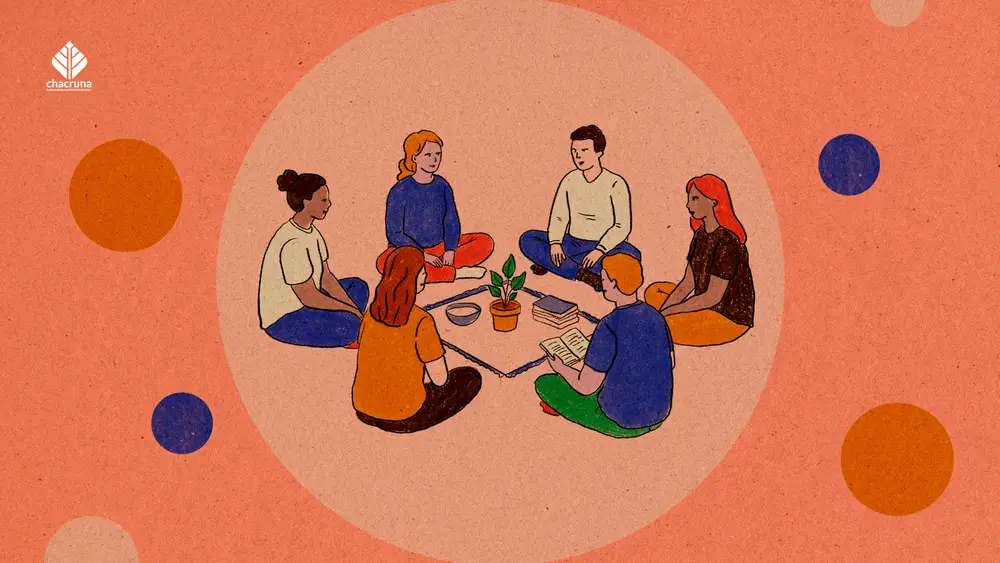
In a clinical setting, lateral allyship may look like a BIPOC psychedelic therapist collaborating with another BIPOC peer to navigate power dynamics that arise when working within predominantly white institutions. For example, two therapists might share insights and debrief about experiences of racial microaggressions from clients or colleagues, offering validation and strategic support. Rather than competing for scarce leadership roles or resources, they uplift one another’s expertise and advocate collectively for structural changes—such as requesting culturally competent supervision or co-authoring research that centers BIPOC healing frameworks.
Additionally, a white clinician practicing lateral allyship in a clinical setting might take proactive steps to challenge Eurocentric norms by integrating culturally grounded practices (with permission and accountability) into treatment plans. This could involve consulting with Indigenous knowledge holders or bringing in community healers as part of a client’s care team. Rather than positioning themselves as the sole expert, the clinician models cultural humility by acknowledging and deferring to other valid ways of knowing and healing. This aligns with McCowan’s (2025) assertion that “cultural humility involves a stance of deep appreciation, respect and curiosity for other cultures and individuals of other cultures”.
In psychedelic community settings, such as integration circles, retreat centers, or activist coalitions, lateral allyship may involve a group member stepping in to address harmful dynamics when they arise, particularly when they hold shared identity with someone causing harm. For example, if a cisgender man of color witnesses another man of color speaking over or dismissing a nonbinary participant, lateral allyship calls on him to intervene, not as a savior but as a peer invested in the collective well-being of the space. This type of intervention—acting within one’s in-group—is an expression of civil courage, which is often difficult but essential for meaningful racial justice (Faber, 2025).
Another example of lateral allyship might involve individuals with relative class or educational privilege in a community circle offering behind-the-scenes support to those with less institutional access. This support could include helping with grant applications, sharing speaking opportunities, or co-creating platforms that center the voices of Indigenous or Black facilitators—without tokenizing or extracting labor. Here, the goal is not to “give voice” but to remove barriers to amplification and affirm the agency already present.
“Liberation psychology centers the marginalized, focusing on the oppressed as experts rather than approaching them with a ‘missionary’ mentality” McCowan (2025). Liberation psychology offers guidance by emphasizing the wisdom and agency of the oppressed. Lateral allyship aligns with this ethic by rejecting hierarchical models of help and promoting collective growth.
While microaffirmations are not substitutes for structural change, they are necessary tools in the broader effort toward justice when paired with action, reflection, and accountability.
Practicing lateral allyship also involves small, everyday actions. Faber (2025) describes the value of microaffirmations: “Supportive and positive statements about a person’s culture can be an important means of helping them feel understood.” In a field that often marginalizes non-Western ways of knowing, these affirmations can help build trust and belonging. For instance, acknowledging and celebrating someone’s use of plant medicine in a traditional or ancestral way during an integration session can foster a sense of safety and respect. While microaffirmations are not substitutes for structural change, they are necessary tools in the broader effort toward justice when paired with action, reflection, and accountability.
Ultimately, lateral allyship is not just about interpersonal dynamics; it is about fostering a cultural shift. In both clinical and community settings, this work invites us to co-create spaces where healing is collective, power is shared, and liberation is truly mutual.
Practicing Cultural Humility in Psychedelic Work
Cultural humility is a cornerstone of ethical allyship. It requires a lifelong commitment to learning, unlearning, and engaging with others from a place of curiosity and respect. McCowan (2025) defines cultural humility as “a stance of deep appreciation, respect and curiosity for other cultures and individuals of other cultures.”
On an individual level, cultural humility in allyship involves critical self-reflection: “Exploring how our biases and experiences affect our worldviews, perspectives, attitudes, behaviors, and approaches” (McCowan, 2025). It means asking ourselves: In what ways do my intersecting identities shape my presence in psychedelic spaces? What assumptions do I carry, and how might they influence whom I listen to, learn from, or unintentionally overlook?
At the interpersonal level, cultural humility requires attuning to power dynamics: “the way our own culture and intersecting identities interact with those of our clients” (McCowan, 2025). Whether as facilitators, therapists, researchers, or community members, we must be attentive to how our presence impacts others. This includes acknowledging when we cause harm and taking responsibility to repair it (McCowan, 2025).
In psychedelic work, where people are often in vulnerable states, the practice of cultural humility is not optional, it is foundational. It is what allows us to build relationships based on trust, reciprocity, and accountability.
In psychedelic work, where people are often in vulnerable states, the practice of cultural humility is not optional, it is foundational. It is what allows us to build relationships based on trust, reciprocity, and accountability.
Reciprocity and Respect in Cross-Cultural Psychedelic Relations
True allyship in the psychedelic field cannot exist without reciprocity. As the medicines and knowledge of Indigenous cultures become more visible in Western contexts, there is a pressing need to move from extraction to an ethical relationship. Platero (2025) reminds us that “Cross-cultural alliances are related to reciprocity, involving exchanges of knowledge, rituals, and resources between cultures.” These alliances must be built on mutual respect and ongoing engagement, not one-time collaborations or token gestures. This includes supporting Indigenous sovereignty, compensating knowledge holders, and protecting sacred practices from commodification (Platero 2025).
Decolonizing psychedelic science also requires challenging the hierarchy of knowledge. As Antunes (2025) notes, “Indigenous knowledge is seen as symbolic while biomedicine is seen as ‘objective.’ Respecting Indigenous methodologies as valid ethnomedical systems is critical”. Lateral allyship in this context means standing beside Indigenous and BIPOC leaders, not speaking for them or simply offering a platform, but co-creating spaces where their leadership is recognized, resourced, and sustained.
Conclusion: An Ongoing Invitation
Allyship in psychedelics is a daily practice of reflection, action, and accountability. Lateral allyship expands this practice by reminding us that solidarity is about reaching across to build relationships rooted in reciprocity, humility, and a shared vision of liberation. In this article, I have explored how lateral allyship can guide our engagement in psychedelic spaces, challenging dominant narratives, uplifting marginalized voices, and fostering ethical, culturally grounded practices. It is an invitation for all of us, BIPOC and non-BIPOC alike, to take responsibility for the spaces we inhabit and the futures we are shaping. Healing is not just a personal journey; it is a collective one—one that calls us to unlearn harmful patterns, stand beside one another, and co-create a psychedelic movement rooted not in hierarchy, but in mutual care and transformation. In that collective journey, allyship is more than support. It is solidarity. It is courage. And it is care.
Art by Michelle Velasco.
References
Antunes, H. F. (2025). From Shamanism to Psychedelic-Assisted Therapy and Back. Chacruna Institute.
Collins, P. H., da Silva, E. C. G., Ergun, E., Furseth, I., Bond, K. D., & Martínez-Palacios, J. (2021). Intersectionality as Critical Social Theory: Intersectionality as Critical Social Theory, Patricia Hill Collins, Duke University Press, 2019. Contemporary Political Theory, 20(3), 690–725. https://doi.org/10.1057/s41296-021-00490-0
Faber, S. C (2025). The Importance of Cultural Competency and Anti-Racist Education for Psychedelic-Assisted Therapy. Chacruna Institute.
George, J. R., Michaels, T. I., Sevelius, J., & Williams, M. T. (2020). The psychedelic renaissance and the limitations of a White-dominant medical framework: A call for indigenous and ethnic minority inclusion. *Journal of Psychedelic Studies, 4*(1), 4–15. https://doi.org/10.1556/2054.2019.015
McCowan, J. (2025). Decolonizing Our Approaches: Embodying the Philosophy and Practice of Liberation Psychology and Cultural Humility in Psychedelic-Assisted Therapy and Research. Chacruna Institute.
Mohanty, C. T. (2005). Feminism without borders: Decolonizing theory, practicing solidarity. Zubaan.
Platero, L. D. (2025). Challenges on Contemporary Expansion of Forest Medicines: Gender and Cross-Cultural Issues. Chacruna Institute.
Spade, D. (2020). Mutual aid: Building solidarity during this crisis (and the next). Verso Books.
Williams, M. T., Faber, S. C., Nepton, A., & Ching, T. (in press). Racial justice allyship requires civil courage: Behavioral prescription for moral growth and change. American Psychologist. [accepted 10/1/2021]