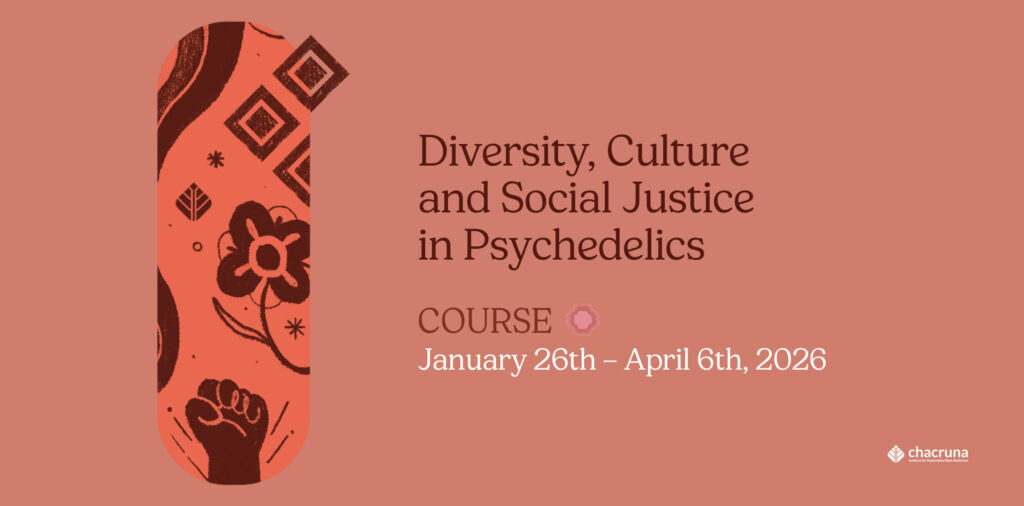
January 26th – April 6th, 2026, 10:30am–12pm PT / 1:30pm–3pm ET
Do you wish you got into this event for free? Become a Chacruna member and receive free or discounted access to all Community Forums, Courses, Workshops, and more! Also get full access to our entire archive of past forum recordings and join our global network of psychedelic professionals and activists to dive deeper into discussion and discovery.
Price $700 USD
Price $320 for CE credits
CE Credits Offered: 16 total
Check our page at Thinkific!
This course is a partnership between Chacruna and University of Ottawa, School of Psychology.

Description
Taught by leading experts and the first of its kind in the psychedelic field, this course will teach students to consider the cultural, social, historical, and economic context that influences the so-called “psychedelic renaissance.” Students will be introduced to basic concepts around psychedelics and justice, diversity, equity, and inclusion (JEDI). The goal of the course is to explore the ways in which psychedelics influence and are influenced by factors such as social justice, privilege, and diversity and to better understand their reciprocal influences on psychedelic science, therapies, and praxis.
Topics include: anti-racism, implicit bias, queer aspects, intersectionality, cultural humility, social identity, power and privilege, healing the racial divide, uses of Indigenous plant medicines, and challenges around their mainstreaming and globalization. This course is intended to be intellectual, personal, and experiential. Students will also be challenged to think critically and confront aspects of themselves, their beliefs, behaviors, and needed areas of growth, such as their individual, familial, and group legacies of privilege and disadvantage, their personal commitments to social justice, advocacy, and social change in the psychedelic community and the world more broadly.
These perspectives are crucial for deepening our understanding of the expanding future of psychedelic medicine in ways that are equitable and just.
Course Structure
The format of the classes is hybrid, including a pre-recorded 1-hour lecture for students to watch on their own time and a 1.5-hour live Q&A and discussion session on Zoom with the professor. Coming into the discussion classes, students are expected to have watched the recordings and read the readings which are listed in the syllabus.
To read more on our recording policy for our trainings and answers to other frequently asked questions, please view our FAQ.
- Students will watch the lecture on their own time
- There will be a live 1.5 hour discussion on Zoom with the professor the following week
Refund Policy click here
Classes
Click on the class to read the description
Class One – Introduction
Monday, January 26th, 2026, 10:30-12pm PST/1:30-3pm EST
Professors: Paula Bizzi Junqueira
In this initial class, students will introduce themselves to others in the course, be introduced to the professors and their backgrounds, and gain an understanding of the curriculum and program. Students will leave with preparation for the following classes being taught and a general understanding of the topics that will be discussed throughout the course.
Class Two – Decolonizing Our Approaches: Embodying the Philosophy and Practice of Liberation Psychology and Cultural Humility in Psychedelic-Assisted Therapy and Research
Monday, February 2nd, 2026, 10:30-12pm PST/1:30-3pm EST
Professors: Joseph McCowan
Our movements for social justice and the modern Psychedelic Renaissance are not separate, but intertwined. Both involve our collective efforts to heal the harms of our pasts, reclaim our human rights, challenge powerful structures and systems, bring balance to areas of imbalance, and prioritize and center what our society has exiled and marginalized. Liberation psychology and Cultural Humility provide the philosophical and practical foundation for us all to be active participants in these movements, regardless of our cultural background, intersectional identity, or our current role or position. Liberation Psychology and Cultural Humility are uniquely aligned with the psychedelic ethos, helping us see and appreciate the complexity, interconnectedness, and interdependence of all things, from society, to culture, to community, and within ourselves and our own psyches. This class will center marginalized and oppressed voices, while decentering dominant voices. There will be focus and discussion on decolonizing our approaches and practices and developing a reflective and critical lens in looking at our current practices and approaches. Learners will engage with a multiplicity of perspectives, voices, backgrounds, practices, and approaches, helping them envision and create new models and approaches for underserved and marginalized groups in psychedelic assisted therapy and research.
Class Three – The Importance of Cultural Competency and Anti-Racist Education for Psychedelic Assisted Therapy: Understanding Aversive Racism and the Power of Identity
Monday, February 9th, 2026, 10:30-12pm PST/1:30-3pm EST
Professors: Sonya Faber
Participants utilizing psychedelic-assisted therapy are in a position of increased vulnerability because it strips people of their normal psychological protections while they also endure immobilization until effects of the psychedelic substances abate. For BIPOC, psychological protections used to navigate interracial interactions are compromised and, therefore, therapy paradigms not centered in understanding the experience and needs of BIPOC people put them at additional risk of harm. Facilitators must unpack their own implicit biases before they can administer these therapies to BIPOC. Multiple studies have shown that people exhibit greater empathy to individuals with a similar skin color and the current situation is that, in the USA, Canada, and Europe, most psychedelic therapists are white, and, as such, most clients of color will be seeing a white therapist. Therefore, it is important to shine a light on cultural competency and implicit bias. There are ways to improve cultural competency racially-based sensitivity to others pain can move from implicit to explicit if made salient. Being a culturally competent therapist requires a better understanding of the tools of systemic racism. Understanding aversive racism and how it develops is a first important step. This class will focus on key issues including aversive racism and the power of Identity.
Class Four – Queer Aspects of Psychedelic Experience
Monday, February, 23rd, 2026, 10:30-12pm PST/1:30-3pm EST
Professors: Clancy Cavnar
This class will explore the dimension of gender-diverse people and sexual orientation in the context of psychedelics. Historically, psychedelics have been used by LGBTQA+ communities as a tool for self-therapy and a creative source among cultural outcastes. We will look at how queer people have used psychedelics to build community and explore identity. This class will also examine a dark period when psychedelics were used to treat homosexuality (“conversion therapy”) in clinics internationally, some times in aversive therapy scenarios. We will look at the ways psychedelic therapy can be made more accessible to gender- and sexually-diverse people, and the ways that queer people might be accommodated and treated with more understanding. The class will familiarize attendees with the particular needs of the queer population in regard to treatment, their continuing struggle to have aspects of gender and orientation respected in clinical contexts with psychedelics, the continuing need for research on this population, and the ways psychedelics can help resolve some of the trauma of being queer in a homophobic society.
Class Five – From Shamanism to Psychedelic-Assisted Therapy and Back
Monday, March 2nd, 2026 10:30-12pm PST/1:30-3pm EST
Professors: Henrique Antunes
While, in the West, psychedelics have often been related to the either the sacred or therapy, in traditional contexts, the uses of these substances can often be found at the intersection of diverse areas of life including politics, medicine, shamanism, religion, aesthetics, knowledge transmission, socialization, and celebration. This class will discuss what traditional uses of sacred plants can teach us about the consumption of drugs in general, and in the context of psychedelic therapies in particular. Can we bridge the world of ceremony with sacred plants to that of psychedelic therapy, or are these ultimately irreconcilable practices, founded on incompatible epistemologies? We will examine different concepts around the notions of healing physical properties of substances versus healing as a relational and cosmological enterprise settings individual versus collective the distinction between synthetics and plant teachers molecules versus interspecies communication who must consume the psychedelic substance for healing to occur therapists, clients, or both for what ages practices are allowed children or adults dosing standard versus individualized training initiation or formal, different ritual techniques, and how excess and malpractice are defined. We will also point out some common misunderstandings in the psychedelic field around the notions of set and setting, as well as problematize the widespread concept of integration. We will conclude by calling the attention of students, activists, therapists, and researchers to honor the Indigenous roots of the psychedelic movement, engage in decolonial practices, culturally sensitive and community-based research, reciprocity, and relationships with Indigenous communities.
Class Six – Psychedelics and Racial Justice: Equity and Access
Monday, March 9th, 2026, 10:30-12pm PST/1:30-3pm EST
Professors: Monnica Williams
Psychedelics have been studied for the treatment of numerous mental health conditions, as an avenue for personal growth, and for enhancing well-being. However, psychedelic research studies have largely excluded people of color, leaving important questions unaddressed for these populations. Additionally, the War on Drugs has created racial barriers to access and estrangement from many psychedelic communities, even as decriminalization is expanding. Dr. Williams will discuss the impact of first-wave drug research abuses, social policies, and stereotypes on communities of color. She will discuss ethnic minority mental health, and how psychedelic therapies may help or hinder healing for racialized individuals. Also discussed are next steps in ensuring that access to culturally-informed care is prioritized, including the importance of culturally-informed approaches and training experiences of psychedelic therapists of color, as several psychedelics move into late phase trials and expanded access.
Class Seven – Challenges on Contemporary Expansion of Forest Medicines: Gender and Cross-Cultural Issues
Monday, March 16th, 2026, 10:30-12pm PST/1:30-3pm EST
Professors: Ligia Duque Platero
Monday, March 16th, 2026, This class will discuss some challenges and paradoxes of the contemporary global expansion of theso-called “forest medicines,” including ayahuasca (the most famous substance), from a historical and anthropological perspective. First, the professor will reflect about her own experience as an anthropologist who is doing fieldwork in ayahuasca rituals as a queer woman in Brazil, both in the Amazon in Indigenous villages and in urban settings like Rio de Janeiro. Next, she will provide an overview on the forest medicines and their contemporary uses: rapé (tobacco snuff), sananga, kambô, and muká. In the second part, she will focus particularly on the case of the Yawanawá Indigenous people of Acre, Brazil, offering an overview of the process of colonization and the
action of religious missionaries for centuries. The class will describe different phases of Yawanawá history, from the rubber boom era to the “rescue of culture” in the 1980s, when shamanic practices were recovered. The class will conclude by discussing the IV Indigenous Conference of Ayahuasca, which happened in Acre, Brazil, in September 2022, when Indigenous leaders presented their concerns about the expansion and globalization of forest medicines. It is hoped that this class offers a good contribution to the reflection on topics such as shamanic tourism, cross cultural alliances, cultural appropriation, and gender relations in shamanic contexts. Attention will be given to both city and forest, and to Indigenous and non-Indigenous perspectives.
Class Eight – Understanding Racial and Ethnic Minorities and the Role of Entheogens in Healing the Racial Divide
Monday, March 23rd, 2026, 10:30-12pm PST/1:30-3pm EST
Professors: Darron Smith
The class will examine the economic and political conditions in US society that give rise to the development and persistence of systemic racism and other forms of oppression that stigmatized minorities (Black, Indigenous, and people of color) face in virtually every domain from educational policy to health care equity. Race still matters. Participants will learn the historical origins of white racial ideologies and how those concepts saturate the imagination of most Americans (whether or not they realize it) while familiarizing themselves with basic sociological theory. This course is intended to give students a broad understanding of race relations in society and how psychedelic (e.g., MDMA, psilocybin, DMT, ayahuasca) might be helpful to heal the racial divide. As such, the fundamental objective of this course is to learn concepts germane to study of racial and ethnic relations in the US.
Class Nine – The War on Drugs, The New Jim Crow, and Moving Away from Punishment as Our Response to Harm
Monday, March 30th, 2026, 10:30-12pm PST/1:30-3pm EST
Professors: Sia Henry
Despite growing public interest in psychedelics, it is important to understand the broader political and social history that led to their criminalization in the first place. This class will discuss the history of racism in the United States that ultimately led to the War on Drugs and mass incarceration. In doing so, it will explore why civil rights activist, Michelle Alexander, declared the War on Drugs the “New Jim Crow,” especially examining what this has meant for low-income communities of color. This class will also touch on conditions of confinement for students to better understand the often unseen harms of the drug war. These harms have been especially detrimental to already vulnerable populations, particularly those with physical and developmental disabilities and individuals with serious medical and mental health issues. Finally, the professor will present a number of steps our society can take to not only end the War on Drugs but construct healthy ways to realize a safer society while addressing harm and creating spaces for healing and accountability. Some of these steps include embracing restorative justice processes that have a long and effective history in African and Indigenous communities around the world.
Class Ten – Conclusion
Monday, April 6th, 2026, 10:30-12pm PST/1:30-3pm EST
Professors: Paula Bizzi Junqueira and Henrique Fernandes Antunes
In this final class, we will strive to summarize everything taught throughout the course. In doing so, we will recap the main concepts, highlight the main moments, and give folks a chance to voice any significant takeaways about the topics discussed. We will also make a critique of the course and think of ways to improve it for future teachings.
Professors
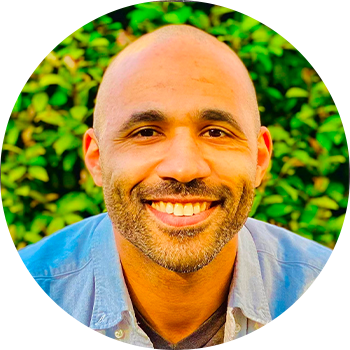
Dr. Joseph McCowan, PsyD, is a licensed clinical psychologist, currently working in Los Angeles as a Co-therapist and Supervisor in the MAPS sponsored Phase 3 clinical trials of MDMA-Assisted Therapy for PTSD. Additionally, Joseph supports the MAPS Therapy Training Program as a training assistant, and supports efforts toward increasing the diversity of therapists and participants in the MAPS clinical studies as part of the MAPS Diversity Working Group. Outside of his work with MAPS, Joseph practices at the California Center for Psychedelic Therapy where he provides Ketamine Assisted Psychotherapy (KAP) and Psychedelic Integration Therapy. Along with his training in MDMA Assisted-Therapy and Ketamine Assisted-Therapy, Joseph is trained in multiple other psychedelic assisted therapy approaches including Psilocybin Assisted-Therapy for Depression (COMPASS Pathways) and 5-MEO-DMT Assisted-Therapy for Depression (Beckley PsyTech). Joseph is deeply passionate about furthering education and awareness of the healing benefits of psychedelics for communities of color and in working to improve mental health outcomes for historically underserved communities and is a member of Chacruna’s Racial Equity and Access Committee. Joseph received his undergraduate degree in psychology from the University of California, Santa Barbara, and his doctorate in clinical psychology from the Chicago School of Professional Psychology.

Dr. Sonya Faber graduated with a Masters in Neurobiology from Brown University after completing her undergraduate work at the University of Pennsylvania. She continued her graduate studies at New York University earning a PhD in molecular genetics with a thesis concentration in signal transduction. Over the course of the last 15 years, she has had the opportunity and privilege to contribute equally to both academic research institutes and commercial pharmaceutical development. She has worked in clinical operations for companies including, IQVIA, Covance and Sanofi-Aventis. Her interests lie in in creating innovative solutions for projects which could benefit both patients and the scientific community, in part by connecting with top scientists, industry and regulatory agencies.In her academic roles, she assessed novel ideas and supported scientists in making these commercially viable while contributing to several original grants and research papers and patents. Her interest in protocol design, medical writing and project management, which she utilized in both pharma and biotech firms, included pre-clinical and clinical activities for phase II and III trials across multiple indications. She has a special interest in training the next generation of clinical researchers and has designed courses to teaching scientific writing and Good Clinical Practice. Dr. Faber is member of the Board Directors of the Chacruna Institute for Psychedelic Plant Medicines.Her engagement on thisBoard is on a volunteer basis and is based on her personal interest in the science of psychedelics, which has long been an interest of hers before taking her current position at Syneos Health.
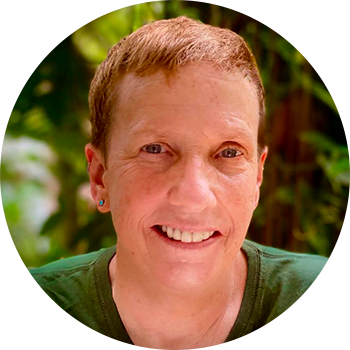
Clancy Cavnar has a doctorate in clinical psychology (Psy.D.) from John F. Kennedy University in Pleasant Hill, CA. She currently works in private practice in San Francisco, and is Co-Founder and a member of the Board of Directors of the Chacruna Institute for Psychedelic Plant Medicines. She is also a research associate of the Interdisciplinary Group for Psychoactive Studies (NEIP). She combines an eclectic array of interests and activities as clinical psychologist, artist, and researcher. She has a master of fine arts in painting from the San Francisco Art Institute, a master’s in counseling from San Francisco State University, and she completed the Certificate in Psychedelic-Assisted Therapy program at the California Institute of Integral Studies (CIIS). She is author and co-author of articles in several peer-reviewed journals and co-editor, with Beatriz Caiuby Labate, of ten books. For more information see: http://www.drclancycavnar.com

Dr. Monnica T. Williams is a clinical psychologist and Associate Professor at the University of Ottawa, in the School of Psychology, where she is the Canada Research Chair in Mental Health Disparities. She is also Clinical Director of the Behavioral Wellness Clinic. Her research focuses on African American mental health, culture, and psychopathology, and she has published over 100 scientific articles on these topics. Current projects include the assessment of race-based trauma, unacceptable thoughts in OCD, improving cultural competence in the delivery of mental health care services, and interventions to reduce racism. She gives diversity trainings nationally for clinical psychology programs, scientific conferences, and community organizations. She currently is Chair of their Academic Training & Education Standards (ATES). She is also a member of the Scientific Advisory Board of the International OCD Foundation, and co-founded their Diversity Council. Dr. Williams is a member of Chacruna’s Racial Equity and Access Committee.
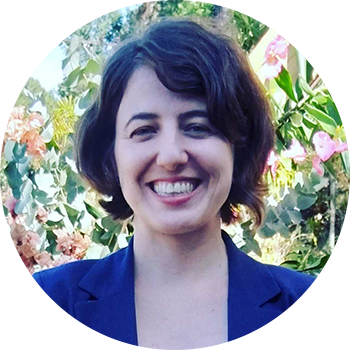
Dr. Lígia Duque Platero is Chacruna’s Education Program Associate. She is a queer, cisgender Brazilian woman. She has an interdisciplinary background in history, anthropology and Latin American studies. She holds a bachelor’s degree in history (2005) and a history teacher training qualification (2006) from the University of São Paulo (USP), in Brazil. She has a master’s degree in Latin American Studies from the National Autonomous University of Mexico (UNAM – 2012) in Mexico City, addressing public policies in relation to Indigenous peoples and Indigenous education in Brazil and Mexico from the 1940s-1970s. She has a doctorate in humanities, with an emphasis on cultural anthropology (2018), from the Federal University of Rio de Janeiro (UFRJ), in Brazil. Her PhD looked at the cultural transformations and exchanges amid the alliance between the Yawanawá Indigenous people and an urban church of Santo Daime. Her main research focus areas are: ayahuasca, Santo Daime, sacred plants, shamanic tourism, Yawanawá (Pano) people, Indigenous policies and human rights in Brazil and Mexico. She is a research associate at the Interdisciplinary Group for Psychoactive Studies (NEIP) and at the Laboratory for the History of Religious Experiences (UFRJ/IFCS) in Brazil.

Darron T. Smith is associate professor in the Department of Family Medicine at the University of Washington. He is a physician assistant and US Army veteran with over twenty years of healthcare-related experience as an educator and mental health practitioner. Dr. Smith has trained with MAPS’ MDMA-assisted therapy. His research and scholarship examine US-based systems of racial oppression and systemic inequality in all societal domains, including healthcare, the family (transracial adoption), healthcare disparities, addiction, religion, sport, culture, and politics. Dr. Smith’s current research and practice intertwine the study of applied neuroscience, race-based trauma, and mental illness by looking at the impact of EEG biofeedback versus MDMA-assisted psychotherapy on brainwave activity in individuals with racial trauma (PTSD) using EEG technology. Dr. Smith serves on Chacruna’s Racial Equity and Access Committee.
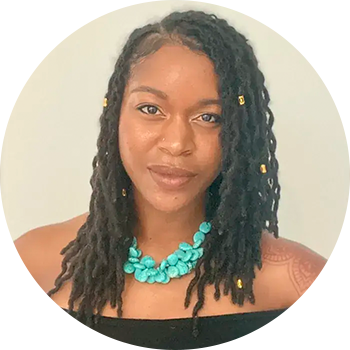
Sia Henry is deeply committed to liberation and racial justice and has spent over a decade in the criminal legal system reform and abolition spaces. Currently a senior policy associate at MAPS, Sia previously supported communities in establishing pre-charge restorative justice diversion programs. She also spent years fighting to improve conditions for incarcerated people with physical and developmental disabilities and mental health issues and those most at risk of sexualized violence. Sia also founded the Hood Exchange, which aims to introduce formerly incarcerated, Black communities to travel throughout the African diaspora. Sia graduated from Harvard Law School and Duke University.
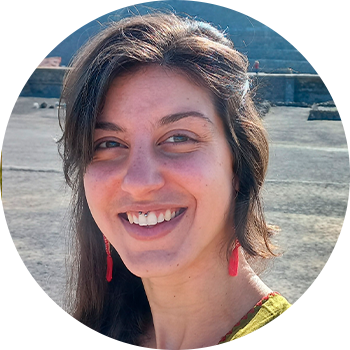
Paula Bizzi Junqueira is a Brazilian anthropologist with a master’s degree from the Center for Research and Higher Studies in Social Anthropology (CIESAS Southeast, Mexico) with a focus on medical anthropology, along with a BA from the University of Brasília (UnB, Brazil). She has carried out research on healing practices with yagé (ayahuasca) in Colombia and the contemporary landscape of peyote in Mexico. She has coordinated the editorial committee of Áltera, a scientific journal produced by the postgraduate program in anthropology of the Federal University of Paraíba (Brazil). Her research addresses the intersections between health and spiritual practices, encompassing themes such as shamanism, relational ontologies, spiritual disciplines and mental health. Paula is Chacruna’s Education Program Assistant and is currently living in Bogotá.
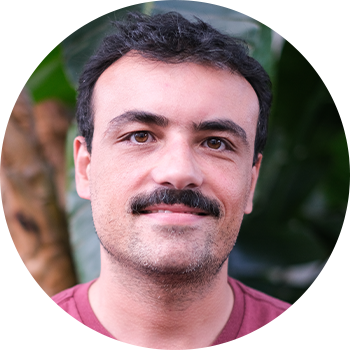
Dr. Henrique Fernandes Antunes holds a Ph.D. in anthropology from the University of São Paulo (2019) and has conducted research as a visiting scholar at UC Berkeley. He earned an M.A. from the same institution in 2012 and a B.A./B.Ed. in social sciences from São Paulo State University (UNESP-FFC) in 2008. His postdoctoral work includes positions at the Centre d’Étude des Mouvements Sociaux (CEMS) at EHESS, the University of Ottawa’s Department of Classics and Religious Studies, and the International Postdoctoral Program at the Brazilian Center of Analysis and Planning (CEBRAP. Dr. Antunes is a member of CEBRAP’s Religion in the Contemporary World research group and coordinates the Ayahuasca Community Committee at the Chacruna Institute for Psychedelic Plant Medicines. He is also a researcher at the Interdisciplinary Group for Psychoactive Studies (NEIP) and a Flourish Fellow at UC Berkeley’s Center for the Science of Psychedelics. His research delves into the regulation of ayahuasca both in Brazil and globally.