Human memory is complicated. What happens when psychedelics are added to the mix?
In September 2025, The New York Times published the story of billionaire and public figure Amy Griffin, who recovered supposed memories of sexual abuse while using MDMA and wrote about it in a bestselling memoir, The Tell. The book was featured by high-profile celebrities including Gwyneth Paltrow and Oprah Winfrey, but inconsistencies and uncertainties at the heart of the narrative have raised essential questions about the veracity of memories Griffin recovered under the influence of these substances. The story has become one of many examples of the tangled relationship between memory and psychedelics.
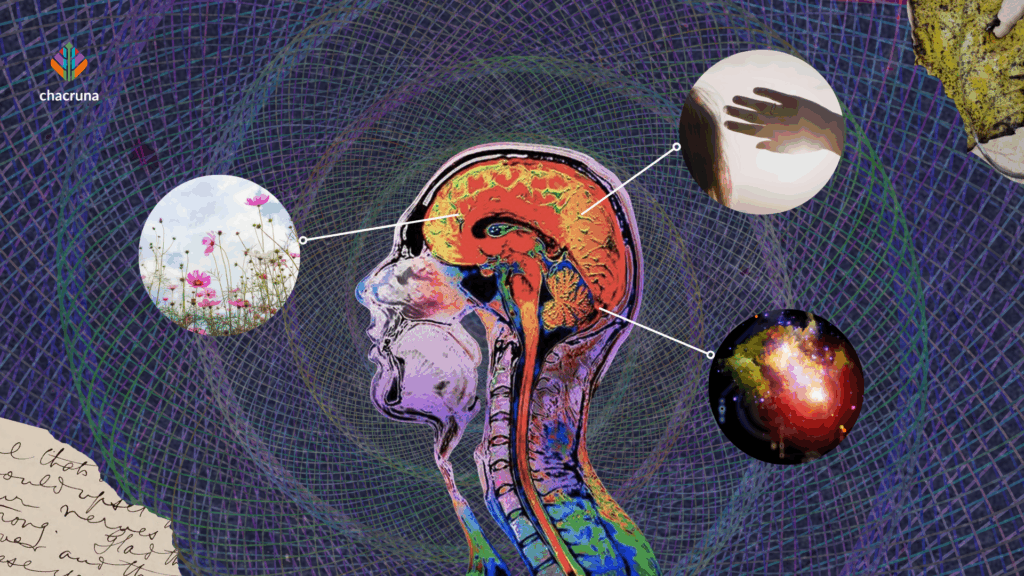
How our memories are stored, retrieved, and function to make up the maps of who we are is dizzyingly complex, and psychedelics can complicate things further, shaping and shifting multiple aspects of memory, including memory encoding and retrieval. Within this topic, thinking about how psychedelics might support recovering memories ranges from skepticism and disbelief to acceptance–with a few critical caveats.
How our memories are stored, retrieved, and function to make up the maps of who we are is dizzyingly complex, and psychedelics can complicate things further, shaping and shifting multiple aspects of memory, including memory encoding and retrieval.
The Many Kinds of Memory
Memory, or the faculty of mind by which the past is stored and retrieved or recollected, actually comprises multiple systems and components.
Declarative memory includes semantic memories that represent your knowledge of your world and things in it that you can declare, such as, “I remember that dolphins are mammals.” Declarative memory also includes episodic memories, episodes or events you remember from your past, like “I remember my elementary school was downtown.”
Autobiographical memory, a subcategory of episodic memory, is the memory of events related to the story you tell about yourself and who you are, including things about your identity, your relationships, and information from different periods of your life.
Declarative memory is explicit, meaning that you can consciously and intentionally call it to mind. Another category, different in kind from declarative memory, is implicit memory. Implicit memory functions below the level of consciousness, and might include things like riding a bike, tying your shoes, and other so-called procedural memories.
Memories before a certain age (around four or five) tend to be implicit, as most adults have no conscious recollection of this period of their lives. However, just as this period of childhood development is critical, the events that happen can trigger emotional reactions later we might not connect back to specific events.
“Implicit memories, including sensations of fear and tension in the body, are heavily dependent on the amygdala and somatosensory systems,” says Dr. Jim Hopper, a clinical psychologist, independent consultant, teaching associate in psychology at Harvard Medical School, and nationally recognized expert on psychological trauma. Implicit memories include efficient and durable associations that do not require conscious recall but can involve strong reactions in the body, like tensing, pulling away, immobility, or vomiting.
Implicit memories include efficient and durable associations that do not require conscious recall but can involve strong reactions in the body, like tensing, pulling away, immobility, or vomiting.
Memories are also processed in different phases: encoding, storage, and recall. Memory encoding refers to how the brain filters our experiences. Human brains do not store every part of an experience. Rather, details are captured based on what captures our attention and what significance is attached to those details. Details that both capture attention and have significance, including sensations and emotional aspects of the experience, can lead the brain to attach to them, encoding them and prioritizing them for storage. What gets extracted for encoding is often based on prior experiences, conditioning, predictions, and evolution and growth. Other details may be peripheral, not regarded as central by the brain.
Parts of an experience that might seem central to someone else could end up being peripheral for people depending on whether or not they dissociate, says Hopper. “People may have no memories of what was happening in their body because they weren’t focused on their body,” he says. “They might have focused on the wall, or a song playing down the hall. Central details might not be what you expect them to be.”
For traumatic experiences like child sexual abuse, recall might be complicated further because it lacks visual elements. “A lot of child sexual abuse happens in bedrooms, in the nighttime, and in the dark,” says Hopper. People who experienced this might not have visual memories, but might recall bodily sensations, sounds, smells, or simple thoughts that are confusing to them when recalled later.
Where do recovered memories, like Griffin’s, fall in this? Recovered memories refer to memories that emerge which someone did not previously have conscious access to. (The older term “repressed memories,” is no longer used, and is considered outdated and problematic.) Whether or not it is even possible to recover memories is a topic of heated debate within the community of memory experts, but even people who believe recovering memories is possible agree that some recovered memories may be false.

Discover the Indigenous Reciprocity Initiative of the Americas
How Psychedelics Affect Memory
The potentially complicated nature of traumatic memories can become even more complicated with psychedelics. Classic psychedelics quiet the Default Mode Network (DMN), which “is very much about remembering and imagining your personal history and narrative: who am I, where did I come from, where am I going?” says Hopper. “When that’s quieted, parameters open into things that don’t fit the typical stories of who I am.”
Psychedelics can increase the likelihood that memories inconsistent with typical dominant life narratives or self-images can emerge. Some, like MDMA, quiet the amygdala and may reduce fears and anxieties that certain memories bring up. That can allow people to feel safer to experience things they may have not felt safe experiencing, or have kept out of their awareness by inhibiting recall.
Ketamine at low doses modulates and blocks signals from the body, which can help people feel safe to be with and explore those signals. Although referred to as a “dissociative,” at low doses ketamine can actually support people who dissociate, says Hopper. “By modulating interoceptive input, ketamine can help people who dissociate from their body to drop into their body. That can lay the foundation for processing intense memories, and can also facilitate new associations and new emotional experiences.”
A quieter DMN allows for more connectivity and interaction between other sensory modes. “We aren’t searching for most memories we have,” Hopper says. “We may hear a song and it reminds us of someone, for example.” This kind of memory retrieval is associative and automatic. In a psychedelic experience, especially thanks to a quieter DMN, the brain is freed up to make more associative connections, which can facilitate recall and open retrieval pathways. A ramping up of emotional and sensory intensity can also facilitate new connections and associations, allowing for the emergence of things that do not typically emerge in normal and less emotionally intense states of consciousness, allowing for more memories to be recalled.
“These are tools that can be used to help people feel safer in their bodies … They can help people to explore emotions, memories, and beliefs they already have. Sometimes they might then go to a place where they remember more – for example they may remember an emotion that went with a sensation.”
Dr. Jim Hopper
Hopper does not recommend using psychedelics to retrieve memories that are otherwise unavailable to them. “These are tools that can be used to help people feel safer in their bodies,” he explains. “They can help people to explore emotions, memories, and beliefs they already have. Sometimes they might then go to a place where they remember more – for example they may remember an emotion that went with a sensation.”
But, he says, “I’m not advising anyone to use psychedelics to recover memory.”
Memory Gets More Complicated
Dr. Manoj Doss, Assistant Professor in the Department of Psychiatry and Behavioral Sciences at Dell Medical School at the University of Texas at Austin, questions the veracity of recovered memories, explaining that they are hard to objectively study.
Often, he says, supposedly recovered memories might be events that people simply have not thought about for some time, or that they learn to interpret years later in a new way. In the case of sexual abuse, that could be learning that you were abused through hearing another person’s account of abuse, resulting in a reframe. “It’s especially true of sexual abuse that people don’t connect the dots,” Doss says. “That’s different from truly recovering something.”
Fear conditioning, he notes, does play a role in various psychological disorders. “There’s no way we can access memories prior to a certain age, around three or four years old, but things that involve the fear conditioning system can still have an impact. When abuse or neglect happen at an early age, people can react later without explicitly having a memory of those events.”
When memory storage and retrieval happen under the effects of psychedelics, there can be a high rate of false alarms. “Memory is this fallible thing,” Doss says, “and the fact is that when you put drugs on top of that, it’s highly unlikely that these drugs will help retrieve memories people didn’t have access to previously.”
Along with that, psychedelics can tune up suggestiveness. “Psychedelics seem to enhance familiarity and fluency processes that can lead to feelings of truthiness – things that seem plausible but aren’t necessarily true,” he says, a phenomenon known as the illusory truth effect. One example? Hearing a statement five times increases its plausibility, whether it is true or false.
He adds that a new study he is about to do will test false memory encoding under the effects of psychedelics. “Psychedelics can potentially increase false memories when trying to retrieve something from the past, in part by increasing mental imagery and suggestibility,” he says. “But another element is that if people keep thinking about a certain idea, it can start to feel very true as well, especially if it’s repeated under the effect of psychedelics.”
“Psychedelics can potentially increase false memories when trying to retrieve something from the past, in part by increasing mental imagery and suggestibility … But another element is that if people keep thinking about a certain idea, it can start to feel very true as well, especially if it’s repeated under the effect of psychedelics.”
Dr. Manoj Doss
“My thinking, which we’ll be testing, is that under psychedelics this can be a memory encoding effect. Instead of having to show a statement five times, maybe we would show it once. Then the second time we show it – we might see that now boom, this thing is true.”
Doss does think there could be uses for psychedelics on memory reconsolidation after traumatic experiences, but major ethical questions would need to be considered. Doss’s deep skepticism does not, he stresses, mean that he would never consider that psychedelics can support memory retrieval. “If psychedelics can objectively enhance retrieval of past memories, I will be the first to eat my own words and publish that data.” However, he says, people need to do “objective research, rather than ‘mesearch.’”
Doss does acknowledge that in the case of false memories, “it doesn’t help people with trauma if you are denying that something happened to someone,” says Doss. “They have to come to that conclusion themselves.”

Psychedelics, Memory, and the “Trauma Narrative”
Many people enter psychedelic states with an intention to know more about themselves and seek to understand the source of their own suffering. Hopper points to the influence of the trauma narrative as another complicating piece of this issue. The familiar language of “set” and “setting” have direct application here.
In terms of set, “people may think there is trauma they don’t remember, or that affected them more than they thought,” he says. “Entering a psychedelic experience with a question or intention like this can be a cognitive set that increases the likelihood of recovering memories that are real, imagining something that never happened, or a mixture of the two. A motivation or longing to know can increase the probability that something will happen.”
The dominance of the trauma narrative in culture can also make people believe that there must be more to remember so they can fully heal themselves. “Even if they’re not really thinking about it, it’s in the aether,” he says. “They might be swimming in a culture with a lot of narratives and hype about psychedelics and recovering memories as a key to healing. Some people do recover memories and it is a part of healing, but not everybody – and even if that happens, it’s usually messier and more complicated than those narratives and hype.”
The influence of the therapist or guide can also shape someone’s experience. “The worst-case scenario is that they have a strong belief that psychedelics are the way to remember things, and that you have to recover memories,” says Hopper. This could result in suggestive questions that lead the person into a false memory direction.
The competence of the guide is critical at working with potentially true or false memories is critical, he explains. However, “just because suggestive influences are there, it doesn’t necessarily mean the person doesn’t have real memories of things that happened,” he says. “But the guide’s incompetence adds a complicating factor and increases the probability of false memories.”
That doesn’t mean that potential effects of psychedelics on memory should not be mentioned by a facilitator as part of informed consent, says Hopper. Rather, explaining that recovering memories or experiencing false memories are among many possibilities can be an important part of preparation. Doing so can help people feel safe to talk about fears of such experiences that many people already have. In contrast, if they go into a psychedelic experience afraid of painful memories resurfacing because they lacked the opportunity to share and process such concerns, it might actually be a self-fulfilling prophecy, increasing the probability that they are flooded by such memories.
Sharing this information with study participants doesn’t sabotage the preparation process for Hopper. The role of staff is to affirm that they have experience supporting people in these states and will be able to help them.
Setting is another important factor. If someone takes psychedelics in a space where they were previously abused, it could trigger memories of that prior abuse. That could also happen depending on who people are with, how safe they feel, the music playing, and things happening in their room or others.
The Way Forward
Despite the many questions about psychedelics’ effects on memory, people who recover memories during or after psychedelic experiences do seek support. The Psychedelics and Recovered Memory Project offers resources for people “who have recovered memories or had memory-like experiences during or after the use of psychedelics.” The project includes a handbook; an archive of research, first-person accounts, and media related to the topic; and a subreddit for people looking for additional support.
The project’s creator, who works anonymously for privacy reasons, recovered memories of childhood sexual abuse during an MDMA-assisted therapy session for their chronic fatigue syndrome.
“When I came out of my first session, I was in complete shock,” they say. “I had no idea it was possible to recover traumatic memories while using psychedelics and I’d had no intention of ‘finding’ anything like that. My therapist, also, was pretty rattled – she had never witnessed a client recovering abuse memories.”
“When I came out of my first session, I was in complete shock … I had no idea it was possible to recover traumatic memories while using psychedelics and I’d had no intention of ‘finding’ anything like that. My therapist, also, was pretty rattled – she had never witnessed a client recovering abuse memories.”
Founder, The Psychedelics and Recovered Memory Project
After searching the internet for anything on the topic and finding very little, they began compiling research and speaking with experts on the intersections of psychedelics and memory. From there, they put together a publicly accessible handbook and archive “so that other people navigating this unique and challenging experience might have access to accurate information. There is so much misinformation out there about how recovered memories are never based in reality or how you can never trust the memories or images that come to you when you’re on psychedelics. I wanted to create a more nuanced, data-driven resource on the topic.”
“When I was putting together the handbook and the archive I was really guided by the question: What would have helped me get through the hardest time in my life? And how can I offer that to others?” The handbook and archive are updated as new research and personal accounts are published.
The handbook does not recommend using psychedelics to recover memory, but instead gives supportive advice. “In my opinion, cautious advice (vetted by experts) is better than the advice of random strangers on the internet, who can really come up with some wild stuff,” they say. “I also noticed that the advice I shared with the people in my life helped them to take informed steps (including, in most cases, trying EMDR/IFS and other gentler approaches to accessing traumatic memories instead of using psychedelics) and it felt like sharing this information with a wider audience might guide people in a similar direction.”
The creator of the Psychedelics and Recovered Memory Project shares that their hope is that people who use psychedelics for healing purposes – including the therapists, coaches, and guides working with them – learn more about how to prepare for and integrate the experience of accessing previously forgotten memories.
“In general, I think that the industry’s turn toward looking at the risks and adverse effects of using psychedelics for healing purposes (alongside their healing potential) is a really positive one,” they say. “More research, education, and public discussion on the topic is definitely needed.”
Art by Fernanda Cervantes.